- Anubhav Sarjer
- Published: 02/03/2026
- Last Updated: 27/08/2026
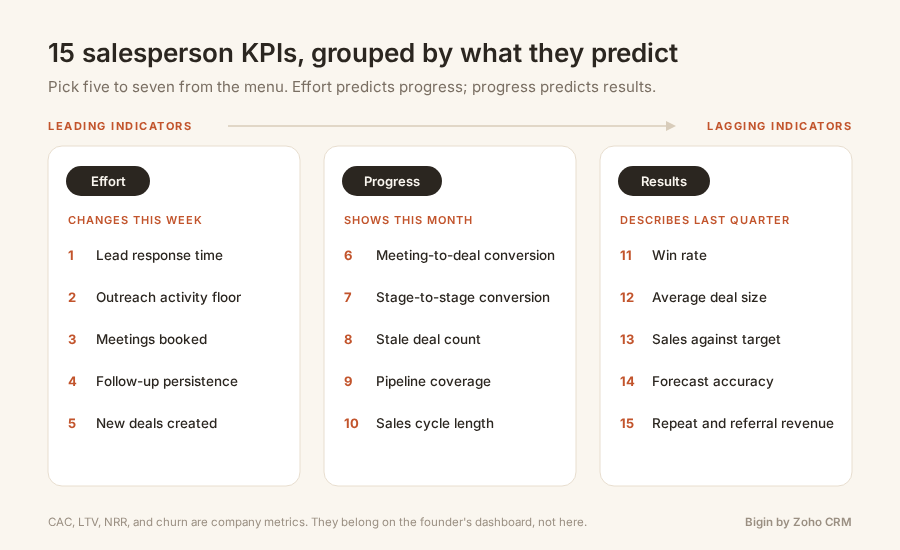
So this is a list of 15 salesperson KPI examples, but with two filters that most lists skip. Can the salesperson move the number through their own work? And does the number mean anything in the deal volumes a small business sees? A five-person team that borrows the scorecard of a 500-person sales organization ends up tracking numbers nobody can influence and trusting ratios that are mostly noise.
A KPI is a metric with a job
A metric is anything you can count: emails sent, deals open, revenue booked. A KPI is a metric someone has promised to act on. "Calls made" is a metric. "Every new lead gets a first reply within an hour, and we check on Fridays" is a KPI, because a named person does something specific when it slips.
That distinction does most of the choosing for you. Before a number earns a place on a salesperson's scorecard, it should pass three tests. The salesperson can change it by working differently this week. It comes out of your CRM without an afternoon of spreadsheet surgery. And when it moves, somebody knows what to do next.
The first test removes more candidates than you would expect. Customer acquisition cost, lifetime value, net revenue retention, and churn are important numbers, and they appear on most lists of sales KPIs, including the previous version of this article. They are company metrics. A salesperson influences them at the margin, alongside marketing spend, pricing, product quality, and support. Put them on the founder's dashboard and keep them off the rep's scorecard, because many reps cannot move, which teaches reps to ignore the scorecard.
How many KPIs should a salesperson have?
Five to seven. The constraint is not collection; it is attention. A KPI only makes sense if it gets a short conversation every week: what moved, why, what changes now. Nobody holds 15 of those conversations. Teams that track everything act on nothing, so treat the list below as a menu; the last section proposes a starting five.
The groups run in causal order, which is the practical version of the leading-versus-lagging indicator distinction. Effort KPIs lead: they change this week and predict next quarter. Progress KPIs show whether the effort is converting. Results KPIs lag: they describe the quarter you already had. A scorecard built only on results finds problems after they have been paid for.
Effort KPIs: the work itself
1. Lead response time
The minutes between a lead arriving and a human replying. This is the most controllable number in sales, with the most embarrassing gap between knowing and doing. In 2011, a Harvard Business Review study audited 2,241 US companies and found the average first response to a web lead took 42 hours, and that firms responding within an hour were about seven times as likely to qualify the lead as those waiting even an hour longer. RevenueHero repeated the exercise in 2024 with demo requests to 1,000 B2B companies: 63.5% never replied, and the companies that did averaged over 29 hours. The bar is on the floor. Reply to inbound leads within the hour, and you are ahead of most of the market. Within 15 minutes, you are nearly alone.
2. Outreach activity floor
Calls, emails, and WhatsApp messages logged per week, read as a floor rather than a leaderboard. Ranking reps by volume produces the obvious disease: more motion, worse conversations. The floor is useful for the opposite reason. When a rep's activity falls to a third of their normal, something is wrong, whether a stuck deal is eating up their week or delivery work has crowded out selling. You want to see that in week one, rather than in the quarter's revenue.
3. Meetings booked
First conversations scheduled per week. For a full-cycle salesperson, this is the earliest number that predicts revenue two or three months out. If meetings dry up while activity stays flat, the problem sits in targeting or messaging, and you have learned it a quarter before it reaches the forecast. It is also the cleanest activity number to set a target on, because a meeting either happened or it did not.
4. Follow-up persistence
The share of open leads carrying a scheduled next step. Most leads do not say no; they go quiet, and the salesperson quietly lets them. Skip the borrowed statistics about how many touches a sale requires, since the popular ones rarely hold up to a source check. Run your own instead: pull last quarter's won deals and count the touches each one took from first contact to close. That count is your floor, and the day-to-day rule is easy to enforce: no open lead without a next step and a date.
5. New deals created
Deals added to the pipeline per month, in counts. A count rather than a value, because at small volumes, one large deal makes value-based pipeline numbers too jumpy to read. A rep who closes well but creates nothing is spending next quarter's revenue. Bigger companies call this pipeline generation; at a small business, it is the plainer question of whether you started enough new conversations to survive a slow month.
Progress KPIs: Is the work converting?
6. Meeting-to-deal conversion
The percentage of first meetings that become qualified deals. It measures discovery. Run high, and the rep may be waving every conversation into the pipeline, which you pay for later in win rate. Run low, and meetings are landing with the wrong people, or the qualifying questions are going unasked. Read it over a rolling quarter at least; ten meetings is not a sample.
7. Stage-to-stage conversion
Where deals leak. An overall lead-to-close rate says you lose deals; stage conversion says where. Losing half your deals between proposal and close points at pricing or an unreached decision maker. Losing them between the first meeting and the proposal indicates a qualification issue. Same overall rate, different leaks, different fixes.
8. Stale deal count
Deals showing no activity and no scheduled next step for 14 days. My favorite KPI on this list is the one that predicts the others. Stale deals inflate pipeline coverage and turn the forecast into fiction. The rule that makes the number useful: a deal idle for more than 14 days gets a task or gets closed as lost. Either outcome is fine. The zombie state is the problem.
9. Sales cycle length
Days from deal creation to closed-won, taken as a median, because one slow whale skews a small team's average by weeks. When cycles lengthen, they usually lengthen in one stage rather than across the board. Find where deals sit longest and fix that stage, whether it is proposals taking a week to leave your side or an approval step the buyer never mentioned until month two.
10. Pipeline coverage
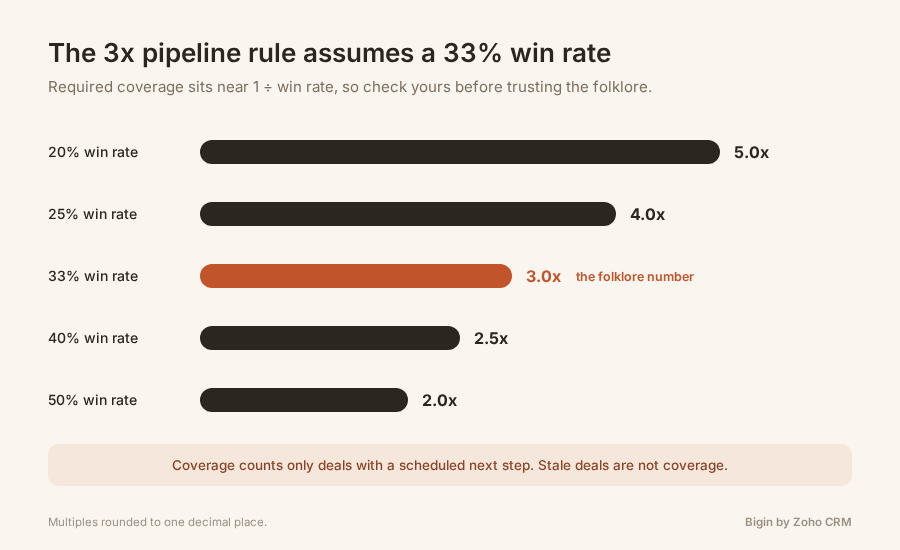
Open pipeline value divided by the revenue target for the period. The folklore says 3x, and the folklore silently assumes a win rate near 33%. Do the arithmetic instead: coverage should sit near one divided by your win rate, so a 20% win rate needs about 5x and a 40% win rate gets away with 2.5x. And coverage built on stale deals is not coverage, which is why this number is only readable next to the stale deal count above.
Results KPIs: what the quarter delivered
11. Win rate
Closed-won deals divided by all closed deals, won plus lost, over a trailing period. Everyone asks what a good win rate is, and the honest answer is that published benchmarks describe somebody else. The Bridge Group's 2024 study of 172 B2B SaaS companies put the median at 19%, down from 23% in 2022, and that sample skews toward mid-market North American software firms with median contract values near $47K. If you sell bookkeeping services or HVAC contracts, the figure describes nothing about you. Your own trailing 12 months is the benchmark that matters, and direction matters more than level.
12. Average deal size
Revenue per closed-won deal. It works as a discounting detector: a slow drift down while win rate holds usually means wins are being bought with price. It also feeds planning arithmetic. A $60K quarterly target at a $5K average deal is 12 wins; at a 25% win rate, that is 48 decided deals, and suddenly the effort KPIs at the top of this list have numbers attached.
13. Sales against target
Revenue closed divided by the target for the period. This is the number the other 14 exist to serve, and the one to be most careful about benchmarking. While rewriting this article, I found five different "quota attainment" figures on page one of the search results: 24.3%, 28%, 43%, 48%, and 51%, each presented as the industry number. They are not contradicting each other so much as measuring different things: the share of reps who exceeded an annual quota, the share at 100% or better, the average percentage of quota booked, and, in one survey, the share who merely expected to hit it. Before a borrowed figure goes into your deck, check its denominator. The cleanest current one is The Bridge Group's June 2026 finding of 48% of reps at quota, and its sanest use is as a caution about target-setting rather than a grade for your team.
14. Forecast accuracy
Of the deals a salesperson commits at the start of a month, the share that closes within it. This is the KPI that teaches honest pipelines. A rep at 90% is sandbagging; a rep at 30% is hoping out loud; around 70%, the commit list starts to mean something. It takes discipline to run, since you snapshot the commit list on day one and score it on day 30, and it repays the effort by converting "trust me" into a number.
15. Repeat and referral revenue
The share of a salesperson's closed revenue coming from existing customers and referrals. In a large company, this drifts to account managers. In a small business, the person who sold the deal keeps the relationship, so the number is fairly theirs, and it is the cheapest revenue there is: no acquisition spend, shorter cycles, warmer starts, better odds. A book that is still 0% repeat business after two years is a treadmill, not a territory.
The small-team problem the lists never mention
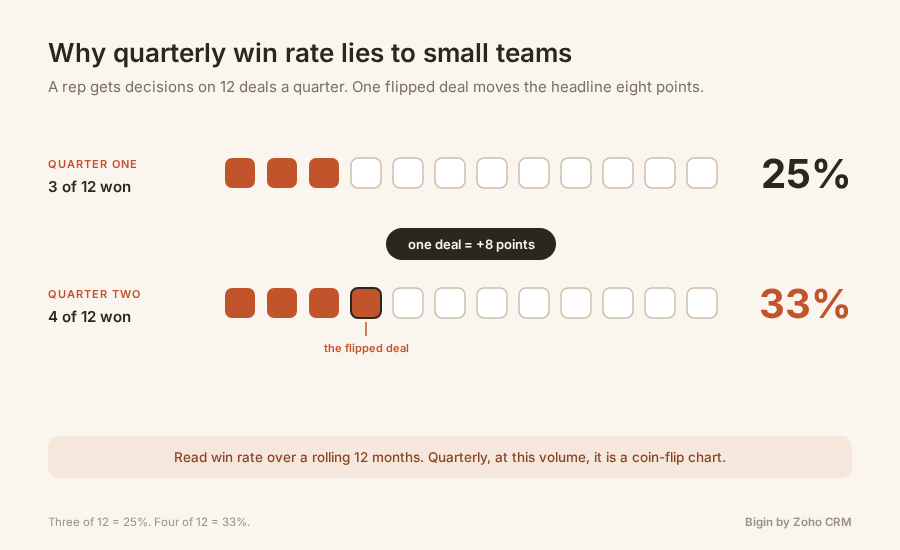
Ratios need volume, and small teams do not have it. Take a rep who gets decisions on 12 deals in a quarter. Three wins is a 25% win rate; four wins is a 33% win rate. One deal moved the headline number by eight percentage points. Read quarterly at that volume, win rate lurches around like a coin-flip experiment, and a manager who celebrates the up-quarters and interrogates the down-quarters is coaching noise.
The fixes are boring, and they work. Read conversion ratios, meaning win rate, meeting-to-deal, and stage conversion, over rolling windows of six to 12 months. Read effort KPIs weekly, because they accumulate fast enough to mean something in days. And compare each salesperson against their own trailing baseline rather than against a teammate working different deals, since with two reps and 20 deals between them, the gap is as likely to be luck as skill.
Setting targets without borrowing someone else's
Skip industry numbers entirely for the first pass. Pull your last two quarters, write down your baseline for each KPI you picked, and set a bounded improvement on one ratio at a time. Response time is the right first target: it sits entirely within the rep's control and pays back in the same week. Everything else starts with holding the baseline.
Then pair every ratio target with a volume floor, because ratio targets invite gaming. A rep graded on win rate alone learns to log only the sure things; the win rate climbs, and revenue does not. Win rate with a deals-created floor, or meeting conversion with a meetings-booked floor, closes that door. When a target has been met for two consecutive quarters, raise it or move to the next ratio.
Tracking the numbers without hiring an analyst
A spreadsheet holds up for one person and a few dozen deals, then it stops being true. The list above runs on timestamps: when the lead arrived, when the first reply went out, when a deal changed stage, and when it was last touched. Nobody types timestamps into a spreadsheet on Friday afternoon, which is why spreadsheet KPI projects die by month two.
This is where I mention that Bigin, where I work, is a pipeline-first CRM built for this size of problem, so weigh the recommendation accordingly. The free plan covers one user, one pipeline, 500 records, and three automations. Express costs $7 per user per month on an annual billing cycle as of August 2026 and adds team pipelines, two-way email, WhatsApp, and workflow automation, which, between them, record most of the timestamps these KPIs rely on. The limits, stated plainly: Bigin is not a BI tool, forecast accuracy still requires a manual month-start snapshot, and a sales team of more than 15 or 20 people should be evaluating a full CRM such as Zoho CRM instead. The trial runs 15 days and requires no card.
Start with five
Fifteen examples were the brief. Five is a useful number: lead response time, the outreach floor, stale deal count, win rate on a rolling year, and sales against target. That set spans all three groups, fits a 20-minute Friday review, and every number on it is one a salesperson can defend or fix by Monday. Add others when a specific question demands them, and retire any number that survives three reviews without changing what anyone does. If you want the timestamps handled for you, try Bigin and set the five up in an afternoon.