- Samira Fernandez
- Published: 11/07/2025
- Last Updated: 10/28/2026
Customer relationship management software is worth paying for when more than one person works with the same customers. If one person handles every lead, remembers every conversation, and follows up on time, a notebook or a spreadsheet does the job. The benefits of CRM show up when two or more people handle the same customer, when conversations occur over phone, email, and WhatsApp, and when a deal goes through several steps before the customer pays.
This article covers six benefits of customer relationship management that I think hold up when you look closely at the evidence. For each one, I have separated the feature, the change in the team's work, and the business result. A reminder is a feature. More consistent follow-up is a process improvement. A higher conversion rate is a business outcome and requires its own evidence. Most writing about the advantages of CRM conflates these three.
The evidence comes from four published Bigin customer stories, and every figure is customer-reported. The table below pairs each benefit with the change in work behind it and a measure you could track.
Benefit | What changes in the work | What you could measure |
|---|---|---|
Shared customer information | Contacts, deals, and conversations sit on one record with a named owner | Share of active customers with a complete record |
Consistent follow-up | Every open deal has a next action, a due date, and an owner | Overdue follow-ups at the end of each week |
Clear handoffs | Required details are captured before a record changes hands | Handoffs that come back with questions |
Reliable pipeline data | Stages, amounts, and expected dates are kept current | Gap between expected and actual close dates |
Less repeated work | Routine record creation and notifications run on rules | Hours of manual entry per week |
Customer context for retention | History is available to whoever serves the customer next | Repeat purchase rate for a defined group |
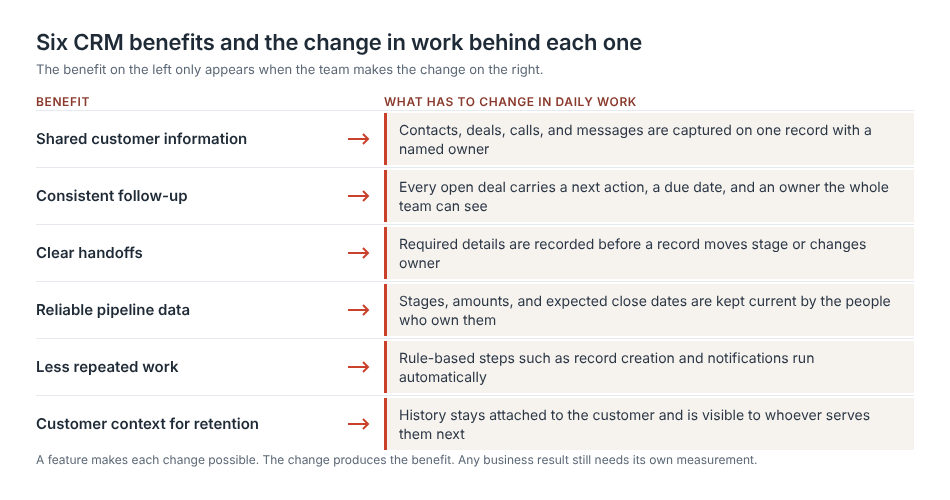
Each of the six benefits depends on a specific change in how the team records and owns its work.
Shared customer information gives your team a usable history.
A quote sits in one person's inbox. Notes from a call sit on another person's phone. Nobody can see the full sequence of what the customer was promised. Littlearth, a hospitality group in South India, described exactly this problem. Its team managed guest data and bookings across several spreadsheets, and conversations were split across phone, email, and WhatsApp, with no shared view. The story puts it this way: "Two major problems surfaced: data silos and communication silos."
A CRM attaches every conversation to the customer it belongs to. The contact, the open deal, the call log, the WhatsApp thread, and the person responsible are all stored in a single record. Littlearth connected its Xtend cloud telephony system so that inbound and outbound calls are automatically logged in Bigin, and it added the WhatsApp integration so that guest messages are stored on the same record. Mohan, Littlearth's Head of Strategy, said: "It has simplified how we manage our guests, helping us spend less time on data entry and more time crafting memorable stays."
A spreadsheet can be shared and searched, so a team can work together without a CRM. What it lacks is the link between a row and the emails, calls, and tasks about that row.
There is one limit to this benefit. A CRM only contains what gets captured. If calls are not connected, notes are not written, or the right people cannot see the record, the shared history has holes. Littlearth's story also reports a 15% increase in revenue after implementing Bigin. That figure is customer-reported, and the story does not separate the CRM from everything else the business did that year, so it is not proof that the software caused the growth.
Consistent follow-up helps sales teams act on opportunities.
Follow-up usually fails without anyone noticing. A lead with no owner, no next step, and no date waits until someone remembers it. Wardle Consultancy, an Australian consulting firm, said that working from spreadsheets and email folders left it without a systematic way to track leads, resulting in missed opportunities and lost sales.
A CRM assigns an owner, a next action, and a due date to every open deal, and makes the status visible to the whole team. Wardle Consultancy moved its pipeline into Bigin, used Team Pipelines and workflow automation, and connected its website through Zoho Flow and Zoho Bookings so customer data populates records without retyping. Zoho Flow and Zoho Bookings are separate Zoho products rather than native Bigin functions.
The team reports the result plainly: "Our lead conversion rates have increased since adopting Bigin," and "We've experienced a reduction in our average sales cycle duration." The story gives no numbers for either statement, so I will not invent an uplift. What the story does document is the change from follow-up that depended on memory to follow-up with a named owner and a due date.
Task completion and customer progress are different things. A team can clear every follow-up task and still lose deals, because making more calls does not mean making better calls. Count overdue follow-ups at the end of each week. Then track conversion for a defined set of leads, such as every lead created in a quarter followed until it closes or is lost, and compare it with the quarter before you changed anything.
Clear handoffs help colleagues continue the work.
Handoffs between colleagues are where customer promises get lost. Sales agrees to a delivery date, operations never hears about it, and service finds out when the customer calls to complain. The information lived in one person's head, and the handoff did not move it to the next person.
L&T-Cloudfiniti, the data center and cloud services division of Larsen & Toubro, an Indian multinational, documents a fix that works. This is a large organization, so I am using it for the workflow lesson and not as an example of a small business. Its Lead Nurturing team transfers leads to the Inside Sales and Direct Sales teams inside Bigin while keeping data private between teams. Stage transition rules prevent a lead from moving to the next stage until required details, such as budget, delivery date, and customer address, are recorded. When a lead is assigned, the new owner gets a system-generated notification, and connected record automation creates records in other pipelines so the next team starts with a record instead of an email.
The colleague who receives the lead opens a record that already answers the questions they would otherwise have had to ask. The same record serves operations and service staff who never move a deal, which is why a CRM is useful to people outside the sales team.
A transferred record proves that the data moved. It does not prove that the recipient understood every commitment the customer heard, and a promise made during a call is recorded only if someone wrote a note about it. Measure handoff quality by counting how often a handoff comes back with questions the record should have answered.
Reliable pipeline data makes reporting and planning more useful.
Pipeline reviews fall apart when the records are out of date. If nobody has updated stages, amounts, or close dates in months, the meeting turns into people reading out their own updates.
When stages, amounts, owners, and expected dates are kept up to date, the team can see which deals moved, which stalled, and which hold the most value. FGrade, an IT consulting and security services company in Hyderabad, India, built dashboard components in Bigin that track calls made, notes added, contacts created, revenue generated, and the number of deals at a particular stage, and it uses these metrics for quarterly and annual KPIs.
Pipeline reporting and forecasting are different jobs. A pipeline report says what is open now. A forecast says what will close, and that needs consistent stage definitions, enough history to know how often deals at each stage close, and a habit of comparing forecasts with results. A dashboard alone does not make a forecast more accurate. Bigin does not advertise a dedicated sales forecasting feature, and Zoho's own comparison page places sales forecasting in Zoho CRM.
The total value of open deals is not revenue you have booked, and booked revenue is not profit. FGrade's founder, Phanindra, says, "Our growth last year was 30%, and I would say this faster growth is happening because we switched to Bigin." That is his own judgment, and the story gives no comparison period.
Automation can reduce repeated work when the process is clear.
Creating the same follow-up task after every demo, notifying a colleague when a deal is assigned, and copying a closed deal into an onboarding list are each small steps, and together they fill a day.
A CRM can take over the steps that follow a fixed rule. L&T-Cloudfiniti sends owner notifications on assignment and creates connected records in other pipelines. FGrade has over 10 automations set up in Bigin, and the story says its team uses APIs to automatically assess existing clients' tech stacks. That API work is a custom implementation, and so are Wardle Consultancy's Zoho Flow and Zoho Bookings connections.
The rest still needs human judgment. Deciding whether a lead is worth pursuing or how to handle an unhappy customer does not follow a fixed rule, and automation that attempts to handle these tasks quickly and at scale makes mistakes.
Automation has its own costs. Rules need maintenance when the process changes. Exceptions need a person to handle them. Wrong or stale inputs produce wrong outputs at scale, and automating a flawed process repeats its mistakes faster. The FGrade story says new employees save 40% of their time because Bigin is the only tool the company uses to manage operations. That figure applies to new employees, as the story states, and it describes time released for other work. Time released is not money saved. It becomes a financial return only when the hours go into work that produces revenue or a cost is removed.
Customer context can support retention and repeat business.
After the sale, the customer continues to engage with your business, often with a different person. If that person cannot see what was bought, what was promised, and what went wrong last time, the customer has to repeat everything, and the relationship starts again from zero.
Whoever picks up the phone can see the record, so the follow-through continues instead of starting over. Wardle Consultancy's team ties this directly to retention: "Bigin's customer-centric approach has positively impacted our customer retention rates." The story provides no retention percentage, cohort definition, or measurement period, so the claim is a customer's description of their experience rather than a measured result.
Keep four ideas separate when you measure this. Repeat purchase is a customer buying the same item again. Retention is a customer still active at the end of a defined period. Expansion is a customer spending more. Customer lifetime value combines all three with margin and time, and you cannot infer it from a retention statement alone. Pick a group, such as customers who first bought in one quarter, define what active means, and check the group at a fixed interval.
A CRM has a hard limit here. It cannot make up for poor delivery, an unsuitable product, or uncompetitive terms. Customer context helps a business that already serves its customers well keep more of them.
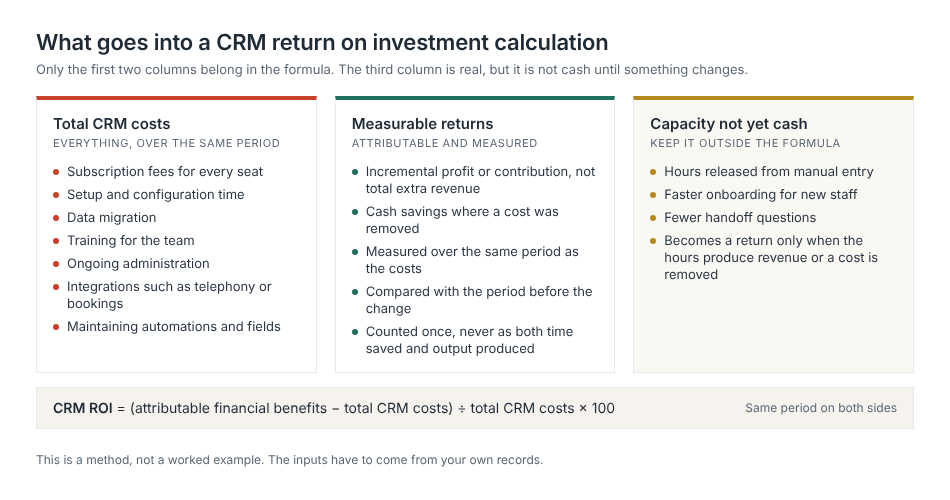
CRM ROI sets attributable returns against full costs, and released capacity counts only when it becomes cash.
Measure CRM ROI against the full cost of using it.
CRM ROI equals attributable financial benefits minus total CRM costs, divided by total CRM costs, multiplied by 100. The hard part is getting the inputs right.
Total costs include more than the subscription. Count setup time, data migration, training, ongoing administration, integrations such as telephony or booking tools, and the maintenance of automations and fields as the business changes.
Benefits must be attributable and measured over the same period as the costs. Use incremental profit or contribution rather than total additional revenue, because revenue that costs money to deliver is not all return. Separate estimated capacity from realized cash savings. The 40% of a new hire's time in FGrade's story is capacity, not cash. It becomes a saving when a cost disappears and revenue when the time produces sales. Do not count the time saved and the output produced in that time as two benefits. That is one hour counted twice.
When do the benefits fail to justify a CRM?
If your business has low complexity, a small number of active relationships, few handoffs between people, and follow-up that already happens reliably, the benefits above are largely in place, and a simpler process is enough.
Benefits also fail to materialize for reasons unrelated to the software. Poor adoption is the most common reason. If half the team updates records and half does not, the shared history has gaps, and nobody trusts it. Too much configuration is another reason. Teams build pipelines, fields, and automations for a process they imagined rather than the one they run. Features the team does not need cost money without changing how anyone works. Weak data ownership, where nobody is responsible for keeping records up to date, means the pipeline review drifts back to verbal updates within a quarter.
Growth is not an automatic reason to buy more software, and there is no customer count at which a CRM becomes necessary. The reason to buy one is shared customer work that keeps failing in the ways described in this article. If you want to think through the design first, our guide to building a customer relationship management strategy covers that, and our customer relationship management examples show what the workflows look like in practice.
Test one workflow in Bigin before you decide anything bigger.
If one of the six failures above is happening in your business now, pick that one and test it in Bigin. Set up the single pipeline that matches it, give each open record an owner and a next date, and run it for a month. That is a smaller commitment than a full migration, and it tells you whether the change in work happens on your team.
Be clear about the dependencies. Stage transition rules are available in the Premier edition and Bigin 360, and connected records require a paid edition. Telephony and WhatsApp need to be integrated, and anything built on Zoho Flow, Zoho Bookings, or the API is configuration work rather than a default. If your team will not update records, no edition of any CRM fixes that. If you are still weighing products, our article on how to choose CRM software for your company is the better next step.