- Anubhav Sarker
- Published: 11/20/2026
- Last Updated: 11/20/2026
How Bending Spoons buys companies

Bending Spoons has spent 13 years buying software that its owners or backers no longer wanted. It usually lets most of the staff go and keeps the product. Its own filings show how the deals get done and who pays for them.
On November 19, Intuit told investors it was selling Mailchimp. The email marketing service had cost Intuit about $12 billion in 2021, roughly half in cash and half in shares. The buyer is paying $3.68 billion. Intuit will take $368 million of that in the buyer's stock.
The buyer is Bending Spoons, a Milan-based company that began in 2013 with $40,000 left over from a failed diary app. Its first acquisition, an iPhone app for customizing keyboards, cost $10,000. It has since acquired more than 50 businesses, including Evernote, WeTransfer, Vimeo, AOL, Eventbrite, Airtable and Miro.
Mailchimp is the largest purchase it has made, and it follows the pattern of the others. Bending Spoons buys familiar software that has lost favor with its owners or the market, usually at a fraction of its earlier price. It lets most of the staff go, rebuilds the technology on its own tools, changes the pricing, and keeps the business. By its own account, it has never sold a material one.
Investors have rewarded it. The company listed on Nasdaq on July 1 at $29 per share and closed that day at $40.50, valuing it at about $25.7 billion. Berkshire Hathaway put $600 million into the offering and another $330 million in October. Revenue was $387 million in 2023. For 2026, the company expects between $3.07 billion and $3.09 billion.
Going public meant explaining itself. A prospectus, two quarterly reports and a presentation to bond investors now set out how Bending Spoons chooses targets, what it pays, what it does in the first weeks and how it funds the whole thing. A proxy statement from Eventbrite, which it bought in March, records one negotiation almost day by day. What follows is drawn from those documents, with reporting from named outlets where the filings stop.
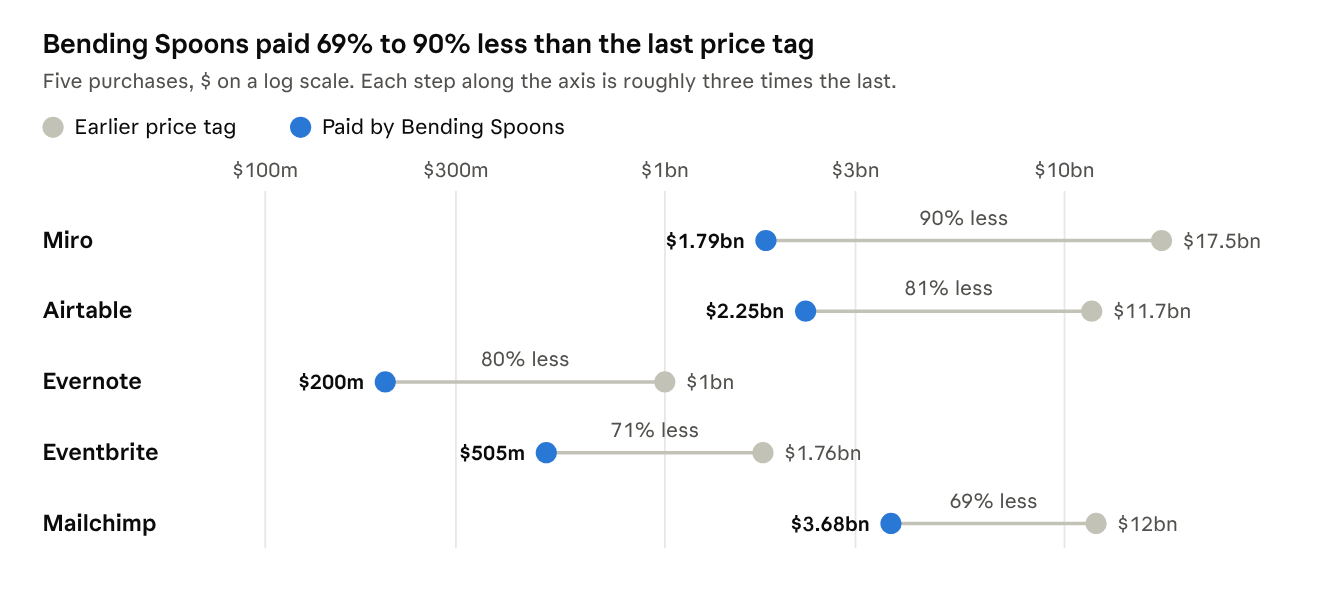
Figure 1. Sources: company announcements, Bending Spoons prospectus and third-quarter accounts, TechCrunch · five purchases, 2023 to 2026. Each earlier figure is the last funding round, flotation, or sale that put a price on the whole company.
A diary app nobody wanted
The founding story opens the prospectus, told in the present tense. On a night in August 2010, on the Indonesian island of Lombok, three newly graduated engineers decided to start a company. Francesco Patarnello, Matteo Danieli and Luca Ferrari called it Evertale. The product was a phone app that used AI to write its users' diaries.
They raised $1 million and hired 10 people. By the middle of 2013, Evertale had almost no revenue and about four months of cash. They liquidated it, kept the remaining $40,000, and started again with two former colleagues, Luca Querella and Tomasz Greber.
The failure produced a theory. Finding a product that people want depends heavily on luck, the founders decided. Running a business well does not. It followed that many products with real customers were probably being run poorly. So the new company would stop inventing products and buy ones that already worked. In the letter's words, it would be "outsourcing the search for product-market fit".
Everything else follows from that choice. The founders write that they treated the operating machine as their most important product, ahead of anything it happened to own. The name refers to bending spoons with the mind. A company with $40,000, five people and one failure behind it, the letter says, could use some irony.
Its stated models are old-economy acquirers: Henry Singleton at Teledyne and Tom Murphy at Capital Cities, and later Broadcom, Danaher and TransDigm.
The second half of the theory is holding on. Bending Spoons says it intends to own what it buys indefinitely, and that when it values a target it largely ignores what the business might fetch in a sale. It gives three reasons never to sell. Nobody else could run the business as profitably. Its engineers rotate between products and would not expect to be sold along with one. And each business is wired so deeply into shared systems that pulling it out would be slow and costly.
That is the line it draws between itself and private equity, which buys in order to sell. In other respects the resemblance is close: borrowed money, deep cost cuts and a required rate of return.
The record has small exceptions. The prospectus mentions proceeds from the sale of a minor business in 2024 and the disposal of an immaterial one in the first half of 2025. The $10,000 keyboard app was shut down six or seven years ago because too few people used it.
The pace has been uneven. More than 10 acquisitions closed in 2017 and none in 2020, when the company built Immuni, Italy's Covid contact-tracing app, without charge. For most of its life, it funded deals with its own cash flow and bank loans. Of the $549 million in new equity it had raised by March 2026, 99% was raised after the start of 2023. That is when the purchases started getting large.
A list of 1,000 targets
The company has counted its possible targets. Working down from tens of thousands of private and public firms, it says it has found more than 1,000 digital businesses it could plausibly buy over the next few years. Together they took in nearly $400 billion of revenue in 2025. Each makes between $50 million and $5 billion a year, is based in Europe or North America, and earns its money from subscriptions or advertising. Of them, 791 are North American.
Few get bought. In 2025, Bending Spoons looked at more than 2,500 opportunities, studied about 200 in depth, and bought six.
What gets through is consistent. The prospectus sets four tests. The product must be digital. There must be a lot to improve. The revenue base must be large. And earnings must be predictable several years out, which in practice means customers who stay, little dependence on paid advertising, years of data to study, and a low risk that AI makes the product redundant.
Growth is absent from the list. The company describes itself as largely neutral on whether a target is growing, since the expected return determines the decision. Mailchimp's revenue fell 1% to $313 million in its latest quarter. Under these rules, that is no obstacle.
Size is on the list because the work does not grow in step with revenue. Ferrari told analysts in August that about 60 of the company's own people worked on Vimeo in the second quarter, roughly as many as rebuilt Evernote in 2023. In the figures in the prospectus, Vimeo's revenue is about four times Evernote's.
The return it demands is steep. For deals closed between 2023 and early 2026, the company says it required 25% a year before borrowing and 65% after. The second figure assumes debt of up to 85% of the purchase price, capped at the amount the target's cash flow could repay over five years. The founders' letter concedes that these hurdles may have to fall as the deals get bigger.
The valuation routine is designed to stop the buyers fooling themselves. Assumptions are written down as probability ranges across dozens of variables. Nobody may run the model, or look at what it says, until those assumptions are final. The stated reason is to keep people from nudging the inputs towards the price a seller wants.
How the Eventbrite deal was negotiated
Having set a price, Bending Spoons tends to hold it. The prospectus says the company makes what it considers a compelling offer at the start and is generally unwilling to raise it by much. The proxy statement Eventbrite sent its shareholders shows the policy at work.
Ferrari met Julia Hartz, Eventbrite's co-founder and chief executive, at the Allen & Company conference in Sun Valley in July 2024. He described how his company buys things. No deal was discussed. A year later, at the same conference, he proposed one.
Five days after that, he sent an email. It named no price. It floated two ideas: that Hartz might put her sale proceeds into Bending Spoons shares, and that she might stay on as chief executive for a fixed period, working beside a senior Bending Spoons manager, with Bending Spoons keeping the final say on the decisions that mattered.
On August 22, 2025, Eventbrite's board received an indicative offer of $4.10 to $4.60 a share in cash, with no financing condition. Seven weeks of diligence turned the range into a number: $4.40.
The board countered at $5.15. The filing records its view that Bending Spoons had historically been disciplined on price, and its hope that a serious counter might move it. Ferrari answered the same day. There might be a little room, he told Eventbrite's banker, but he would not do a deal at or near $5.15. Nine days later the offer rose to $4.50.
Eventbrite's bankers then went looking for someone who would pay more. They approached 13 trade buyers and nine financial ones. Seven signed confidentiality agreements. One bid, at $4.25; declined to go higher. The board signed on December 1 at $4.50, which Bending Spoons had described as its best and final price. The price had moved by $0.10 since October.
For shareholders, the price was 81% above the last close of $2.49. For anyone who had held since the 2018 flotation, which valued Eventbrite at $1.76 billion, it was a sale at about $500 million.
Hartz did not stay. The filing says she would have no role after closing. She was offered the chance to buy Bending Spoons shares with her after-tax proceeds, at the valuation of its last funding round. Her request to roll her share options over on tax-favorable terms was refused.
One detail explains the hurry at the end. Bending Spoons wanted the deal announced before it went to lenders for a new term loan at the start of December.
Who it buys from
The sellers sort into three kinds.
Some are corporate parents shedding a unit: Intuit with Mailchimp, Yahoo with AOL, IAC with a bundle of mobile apps it called Mosaic.
Some are listed companies whose shares had sunk. Brightcove, Vimeo and Eventbrite were all taken private. Eventbrite's buyer paid 81% over the market price and still got the company for less than a third of its flotation value.
And some are venture-backed companies that were priced for a boom that ended. Miro raised money in January 2022 at a $17.5 billion valuation. Bending Spoons bought it this October for an equity value of about $1.79 billion. Airtable was worth about $11.7 billion to its backers in December 2021, including the $735 million they had put in, and was sold for about $2.25 billion. Evernote, valued at $1 billion in 2012, went for $199.7 million.
Some sellers now take part of the price in Bending Spoons shares. Miro's former shareholders put $295 million back in. Intuit will hold $368 million.
The company expects the supply of sellers to improve. Its prospectus argues that AI leaves many single-product software firms exposed, and that this could make their owners readier to sell, at lower prices.
The spending has compounded. Bending Spoons closed one deal in 2023, Evernote, at an enterprise value of $194 million. In 2024 it closed five for $876 million, and in 2025 six for $1.92 billion. This year AOL, Eventbrite, Tractive, Airtable and Miro have closed for a combined $5.4 billion. Mailchimp, at $3.68 billion, is due early next year.
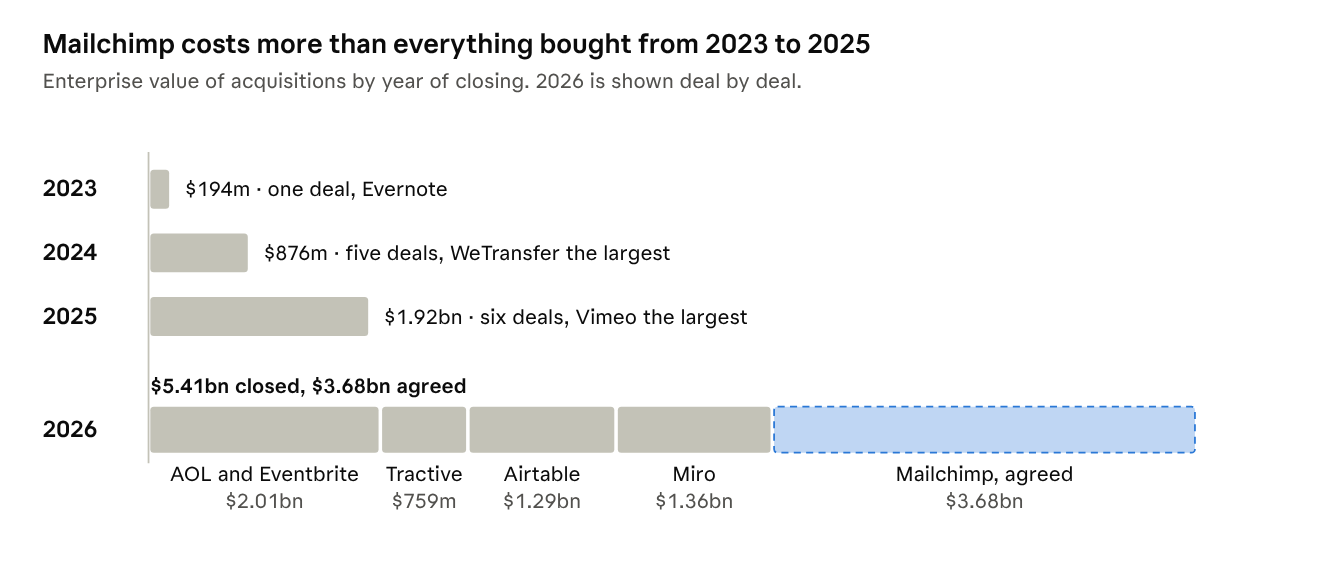
Figure 2. Enterprise value of acquisitions by year of closing, with 2026 shown deal by deal. Mailchimp is agreed but not closed. Sources: Bending Spoons prospectus, second- and third-quarter 2026 results, deal announcements.
What happens after a deal
The work starts before the deal closes. As closing nears, the prospectus says, Bending Spoons assembles a task force of its own staff, usually dozens of them, covering engineering, data science, design, product, and growth. Most have done it before on another product. After closing, they spend a few weeks to a few months inside the business, often talking one-on-one with most of the people who work there, reading the code, and interviewing customers.
Then they write a plan: a new organization chart, a list of technical fixes, a product roadmap, and a set of pricing and marketing experiments.
The organization chart is where the controversy lies. The company's risk disclosures say it has frequently cut staff after acquisitions and expects to do so after each one. It calls its own people Spooners, hires them through a separate and highly selective process, and moves them between products at short notice. The staff who arrive with an acquisition are a different category. Most do not stay.
The prospectus gives numbers. Evernote had 341 full-time equivalent staff when it was acquired in January 2023. By the end of 202,4 it had 60, nearly all of them Spooners. Four layers of management became two. StreamYard went from 154 to 44 in under a year, and head office absorbed almost all of its administrative work. Remini came with no team at all.
At WeTransfer, the company confirmed to TechCrunch in September 2024 that it planned to cut 75% of its workforce, which TechCrunch, citing Dutch media, put at more than 350. Ferrari explained that the company determines what an acquired business should become, then closes the gap as quickly and as fully as it can.
The largest case is the latest one the filings quantify. AOL, Eventbrite and Vimeo brought 1,830 full-time-equivalent staff between them in late 2025 and early 2026. The prospectus says many had already gone by March, and that only a few hundred would remain once the three overhauls were finished later in the year. At Vimeo, a layoff was announced on January 20, eight weeks after closing. At Airtable, the cuts came on October 12, less than six weeks after closing. A Bending Spoons product executive, Federico Simionato, said they reflected the company's belief that small teams ship more, and better, work.
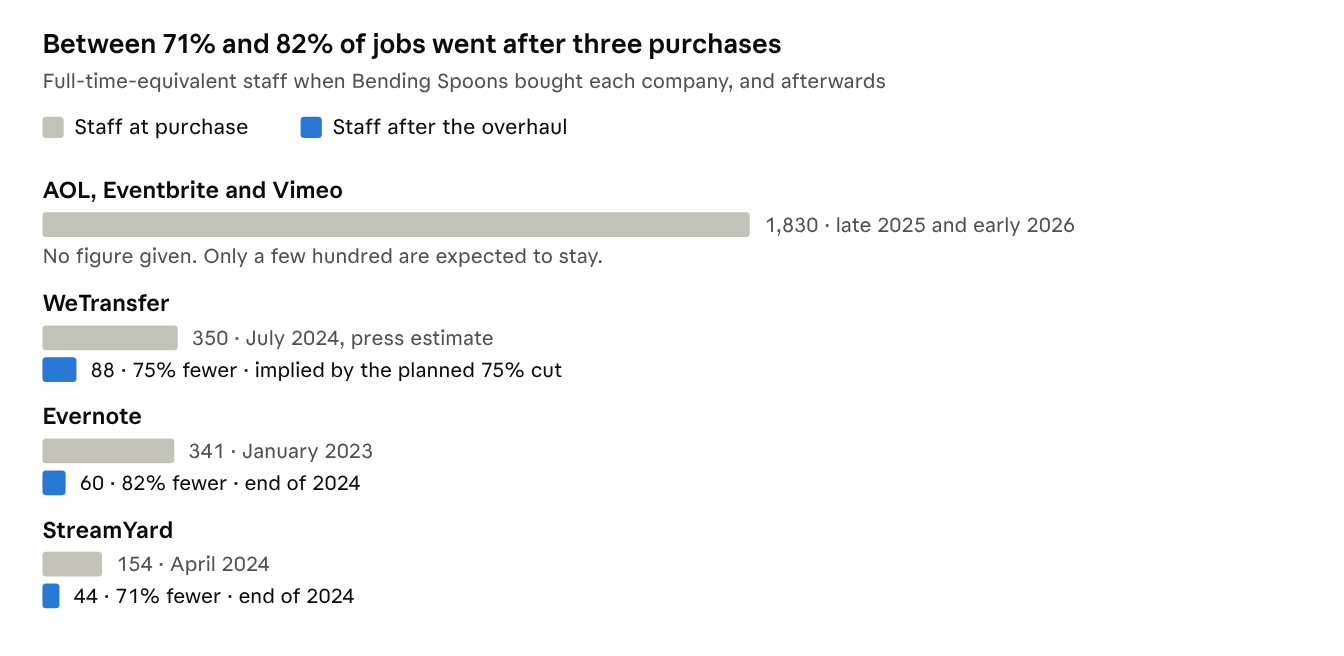
Figure 3. Full-time-equivalent staff at purchase and after reorganization. The WeTransfer after-figure is arithmetic from the planned 75% cut. No later figures have been published for AOL, Eventbrite, and Vimeo—sources: Bending Spoons prospectus, TechCrunch.
The company says departing staff get substantial support, and the accounts put a price on it. Reorganization costs, mostly separation packages, were $14 million in 2023, $52 million in 2024, and $79 million in 2025. In the first nine months of 2026, they came to $152 million.
What replaces the departed is a small team and a lot of shared machinery. The acquired product is moved onto Bending Spoons' own systems for data, payments, and experiments. One estimates what each user will be worth over time. Another handles billing and price changes, allowing the company to take subscription management away from outside vendors soon after a deal closes. The experiment system ran more than 3,000 tests across the portfolio in 2025.
AI has made the small teams smaller. The company estimates that the share of its code changes written or co-written by AI went from under 10% in early 2025 to more than 90% a year later. Revenue per Spooner was $1.12 million in 2023 and $2.57 million in 2025. Ferrari said in August that it was running at over $4 million per year.
The same standard applies to its own people. In 2025, Bending Spoons received about 800,000 job applications and hired 286. Some 16% of Spooners left that year, and the company says it wanted all but a sliver of those departures. Its filing states plainly that it parts with staff who are performing adequately when it thinks stronger ones are available.
What changes for customers
Pricing changes early. At Evernote, the company opened every feature to free users, then limited how much of the product they could use. TechCrunch reported that the free tier was cut to 50 notes in November 2023. By the company's count, upgrades triggered by hitting a limit roughly doubled between 2022 and 2024, and revenue per active user in 2025 was two and a half times its 2022 level.
The prospectus is candid about the other side of that. Evernote's revenue rose in 2024 because each subscriber paid more, though the number of subscribers declined.
WeTransfer's free plan was capped at 10 transfers a month in December 2024, within five months of the purchase. At StreamYard, an automated system now looks for individual accounts that behave like businesses and moves them to business plans.
The products do change. Evernote's releases rose by half in 2023 and doubled in 2024. The company fixed more than 6,000 reliability problems in three years and redesigned the apps. New sign-ups had fallen by about a fifth in each of the three years to 2023. They rose 29% in 2024 and 20% in 2025. Remini, a photo app bought in 2021, made more than nine times as much revenue in 2025 as it had before the purchase.
In October, the company gave bond investors an average across the deals it has done since 2023. Six quarters after purchase, revenue was 32% higher, and adjusted operating costs were 59% lower. Those two numbers are the business.
What the accounts show
Revenue was $387 million in 2023, $671 million in 2024, and $1.31 billion in 2025. In the third quarter of 2026 alone, it was $780 million.
Nearly all of that growth was bought. The company reports what its businesses would have done without new acquisitions, a figure it calls organic growth. It was 7% in 2024 and 13% in 2025. In the three quarters of 2026 reported so far, it was 6%, 3% and 3%, against headline growth of more than 120% each time.
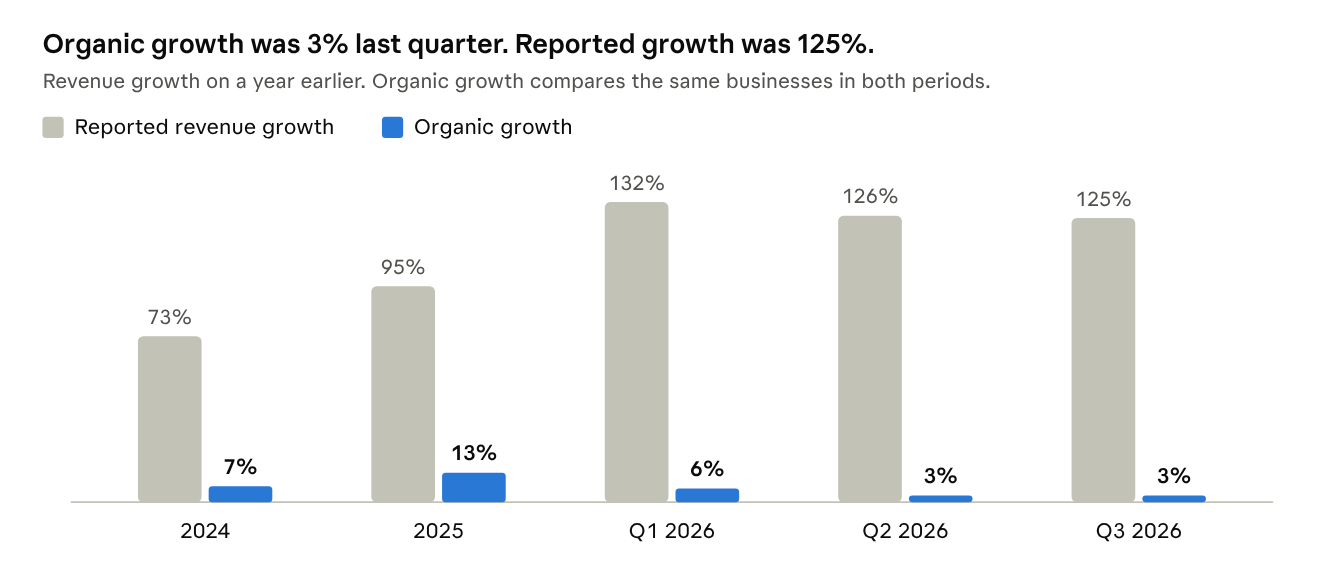
Figure 4.Year-on-year revenue growth, reported and organic. Organic growth compares the same businesses in both periods. Sources: Bending Spoons prospectus, second- and third-quarter 2026 results.
Some of the older products are shrinking. Ferrari told analysts in August that Remini and Splice had declined in the second quarter. Brightcove lost subscribers in 2025. The strongest contributors lately have been WeTransfer and Tractive, a pet tracker bought in May.
Profit depends on which line you read. The company's preferred measure, adjusted operating income, excludes the amortization of acquisition costs, deal fees, and reorganization costs. On that basis, it made $613 million in 2025, a margin of 47%. Operating income under standard accounting was $278 million. After $143 million in interest and a tax charge swelled by the relocation of acquired businesses to Italy, the year ended with a net loss of $204,000.
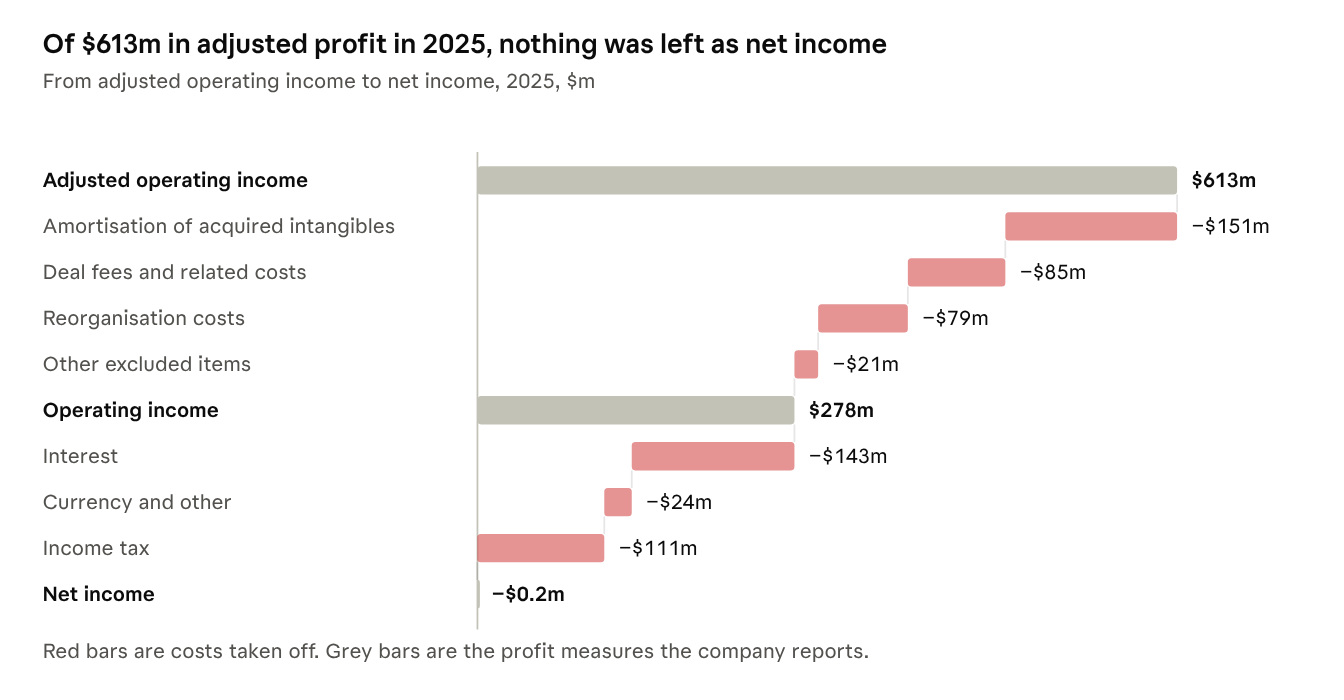
Figure 5. From adjusted operating income to net income, 2025. Source: Bending Spoons prospectus.
The case for the adjusted figure is that severance and deal fees are one-off costs. The case against is that a company which buys something every few months pays them every few months.
This year the gap has narrowed. Net income for the first nine months of 2026 was $295 million, according to the third-quarter results.
Debt and funding
The purchases are paid for mostly with debt. Borrowings stood at $389 million at the end of 2023, $2.67 billion at the end of 2025, and $4.91 billion this September. The October presentation to bond investors, which includes the Miro purchase and related financing around it, shows gross debt of $6.64 billion against $1.52 billion in cash.
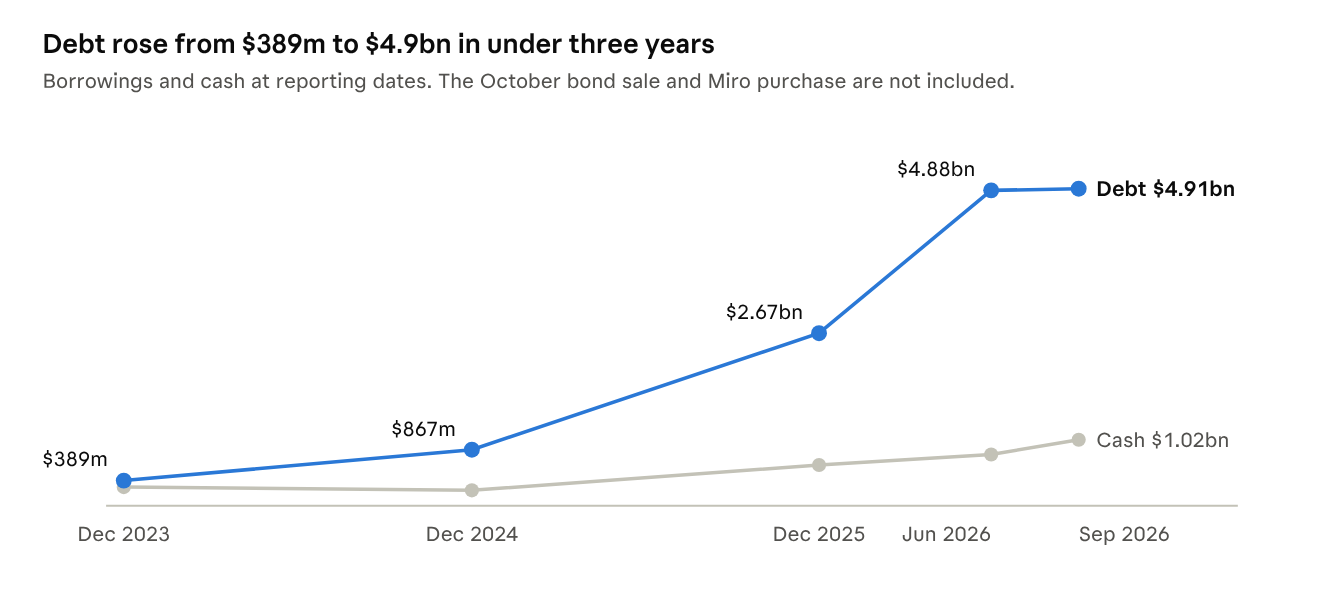
Figure 6. Debt and cash at reporting dates, December 2023 to September 2026. The October 2026 bond sale and the Miro purchase are not included. Sources: Bending Spoons prospectus, second- and third-quarter 2026 results.
It is not cheap money. The main dollar loan costs about 9.2% a year after hedging. In November, the company sold its first bonds: $1.25 billion at 9.625% and €500 million at 8.625%, both due in 2032. Interest expense was $17 million in 2023 and $143 million in 2025. In the second quarter of 2026 alone, it was $109 million.
The company puts its leverage at 2.1 times earnings, comfortably within the 4.0 limit set by its lenders. The definition matters. The earnings in that ratio count each acquired business as if it had been owned all year and include cost savings, both those already realized and those still expected. In the 12 months to June, the bond presentation shows, $505 million of the $2.26 billion total was savings the company expected but had not yet delivered.
New shares are issued sparingly. Before the flotation, the company had raised $549 million of fresh equity in its whole history. The July IPO raised $1.10 billion for the company after fees, with existing shareholders selling stock alongside the company. On the day it agreed to buy Mailchimp, it also arranged to sell 32.5 million new shares to institutional investors at $40 per share.
Control has barely been diluted. The four co-founders still at the company hold shares that each carry five votes. After the IPO, the prospectus shows, they had about 83% of the votes between them.
One more disclosure deserves notice. The prospectus reports material weaknesses in the company's financial controls. The fixes it lists include better controls over unusual transactions and over the integration of newly acquired businesses into its reporting.
Criticism and risks
The people who lose their jobs have the plainest objection. After Vimeo cut a former engineer, Derek Buitenhuis, wrote that it hurt to see something he had built destroyed by what he called "private equity dressed up as a technology company."
Founders have complained too. Nalden, who co-founded WeTransfer in 2009, criticized what had become of it last December and is building a rival file-transfer service.
Bending Spoons does not hide from this in its filings. It warns investors that reorganizations and price increases may damage its brands, and that a reputation for layoffs could make owners reluctant to sell to it. It discloses that it has faced employment claims connected to reorganizations.
Its defense is the customer numbers. Net revenue retention across the portfolio was 95% in 2025. At Evernote, it averaged 99% over three years. Nearly half of subscription revenue comes from customers of at least five years' standing. Matteo Danieli, a co-founder, told TechCrunch on the day of the listing that retention had been remarkably stable through the price changes. The company has also told bond investors that it has never lost money on a material acquisition.
The same numbers allow a less flattering reading. A retention rate of 95% means that revenue from existing customers shrinks by 5% a year before any new ones arrive. And the customers who stay longest are often the ones who would find it hardest to go. The prospectus says as much about Evernote, which it valued partly because many users had thousands of notes stored there and had built their working habits around it.
The company's own list of risks is long. The growth is acquired, so it slows if the deals slow. The deals need debt at 9% or more. The teams that do the overhauls are finite: about 700 Spooners are absorbing five businesses bought this year, and Ferrari said in August that he could not rule out having to slow the buying from time to time. Large targets are also scarce. Of the more than 1,000 companies on its list, 94 have revenue above $1 billion.
What's next?
Mailchimp is a different order of purchase. At $3.68 billion, it is more than twice the size, by enterprise value, of anything Bending Spoons has bought before. It brings in about $1.26 billion a year, close to the revenue of Bending Spoons' total revenue in 2025. The price is about 2.9 times that revenue.
The arithmetic of the model is simple. Buy at two or three times revenue. Take out more than half the costs. Raise prices where customers will bear it and keep most of them. A business bought with 9% money can then return a great deal more than 9%. Evernote suggests it works: bought for $199.7 million, it produced $95 million in revenue and $11 million in pre-tax profit in its first year, which also included $14 million in severance.
Each step leans on something the company does not control. Sellers have to keep accepting low prices, which they have done during a slump in software valuations. Lenders have to keep lending. Customers have to keep tolerating the price changes. And about 700 people have to keep absorbing businesses several times larger than the last.
Three numbers are worth watching. The first is organic growth, which was 3% last quarter. If it turns negative, the portfolio is shrinking underneath the acquisitions. The second is the gap between the cost savings the company expects and those it has delivered, which indicates whether the overhauls are keeping up with the buying. The third is the price of its debt, because the model needs a wide spread between what it pays lenders and what it earns on deals. The founders have already told investors that the return they demand on new deals may have to fall.
Bending Spoons would say none of this is new, and 13 years of results support it. But the record was built on smaller deals. Mailchimp costs 18 times as much as Evernote did, and it is due to close early in 2027.
-
This article was developed with the assistance of AI tools, including ChatGPT and Claude, for research, fact-checking, cross-referencing, and drafting. While we have made every reasonable effort to verify the accuracy and reliability of the information presented, we encourage readers to independently verify any information before relying on it for personal, professional, commercial, or other purposes.
Sources and method
Figures come from company filings and press releases unless a news outlet is named. Five things are my own work (with the help of Claude, of course) and should be read as such: the sorting of sellers into three kinds, the comparison of Vimeo's revenue with Evernote's, the share of lender-defined earnings made up of expected savings, Mailchimp's price as a multiple of its revenue, and the WeTransfer headcount after its cut, which is arithmetic from the planned 75%. Earlier valuations are the last funding round or sale price that the seller disclosed. They are set against the equity value or purchase price Bending Spoons paid, which is not always a like-for-like comparison. Neither Vimeo nor Airtable has disclosed how many people were laid off. The share price today is omitted because it fluctuates daily.
Company and regulatory documents
- Bending Spoons, IPO prospectus, filed with the SEC on July 1, 2026
- Bending Spoons, third-quarter 2026 results and financial statements, November 19, 2026
- Bending Spoons, second-quarter 2026 results and prepared remarks, August 13, 2026
- Bending Spoons, presentation to bond investors, October 20, 2026
- Bending Spoons announcements on Mailchimp, Miro, Airtable, Berkshire Hathaway and its bond sale
- Eventbrite, definitive proxy statement, 2026
- Intuit on selling Mailchimp, November 19, 2026, and on buying it, November 1, 2021
- Miro on its 2022 funding and Airtable's investors on its 2021 funding
Reporting
- Axios, interview with Luca Ferrari, July 1, 2026
- TechCrunch on the first day of trading, an interview with Matteo Danieli and a history of the company, July 2026
- TechCrunch on layoffs at WeTransfer, September 8, 2024, and Vimeo, January 22, 2026
- Engadget on the Vimeo layoffs, January 23, 2026
- Business Insider, republished by Yahoo Finance, on the Airtable layoffs, October 12, 2026
- TechCrunch on Evernote's 2012 funding, May 3, 2012