- Samira Fernandez
- Published: 02/02/2026
- Last Updated: 18/08/2026
If you run a small business, your pipeline has one job. On any given Monday, it should tell you which deals need something from you this week, and which ones are quietly dying. A borrowed template cannot do that. Your own closed deals can.
What follows is the order I would build one in, including the arithmetic for how big it needs to be and the two or three parts almost everyone skips.
Pipeline, funnel, process: what the words mean
These three get used interchangeably, which causes real confusion the moment you start reading around the subject.
A sales pipeline is a list of live deals. Each one has an owner, a value, a stage, and an expected close date. It answers a per-deal question: what does this specific opportunity need next?
A sales funnel is the same journey seen in aggregate. It answers a volume question: of the 100 inquiries that arrived last quarter, how many turned into quotes, and how many turned into customers?
A sales process is what you actually do at each stage: the calls you make, the questions you ask, the documents you send. The pipeline tells you where a deal stands. The process tells you what to do about it.
You will want all three eventually. Build the pipeline first, because the other two are assembled from its output. So to that end, let's see how to go about building a sales pipeline.
Step one: read your last 20 closed deals before you draw anything
Open your inbox, your calendar, and your invoicing tool, and pull the last 20 deals that reached a decision. Include the ones you lost. Especially those.
For each, write down the sequence of what happened, in order, with dates. Not what should have happened. What did. Something like: inquiry through the website on 3 March, called back the same afternoon, site visit on 11 March, quote emailed 14 March, chased twice, signed 2 April.
Do that 20 times, and the pattern surfaces on its own. You will find four or five moments that appear in nearly every deal you won and are missing from most of the ones you lost. In a services business, it is often the site visit or the scoping call. In a product business, it is often at this point that a second person from the buyer's side joins the conversation. Those moments are your stages. You did not invent them. You found them.
Fewer than 20 closed deals so far? Use what you have, weight it towards the losses, and repeat the exercise in six months. Ten deals will show you the obvious steps, but not which of them separates a win from a loss. Around 60, the pattern gets strong enough to trust over your own hunch.
Step two: name the stages after something the buyer did
The most common fault in a new pipeline is using stage names that describe how the seller feels. Warm. Nurturing. Following up. Hot lead. Nobody else can check any of these, so the pipeline stops being a shared record and turns into a mood board.
Name each stage after something observable that the buyer did or agreed to. Scoped. Quote sent. Verbal yes. A stage is a state the deal is in, and a deal sits in exactly one of them at a time.
Two more rules save trouble later. Stages should never describe time, so "Q4 deals" or "30 days out" belong in a filter rather than your stage list. And deals should only move forward through stages, or your conversion rates stop meaning anything.
On how many stages: four to six suits most small businesses, and the reason is arithmetic rather than taste. Each stage needs enough deals passing through it for its conversion rate to be worth reading. Close 60 deals a year, spread them across 10 stages, and every number on your dashboard is noise. Close, whose guidance is written for higher-velocity B2B teams, recommends five to seven stages for that motion and three to five for transactional B2C selling. Small businesses usually belong at the lower end of either range.
Step three: write exit criteria a stranger could check
This is the step that separates a working pipeline from a row of coloured columns.
For each stage, write one sentence describing what has to be true before a deal leaves it. The test is whether someone who was not on the call could verify it. "Prospect seems keen" fails that test. "Buyer confirmed a budget range and named the person who signs" passes it.
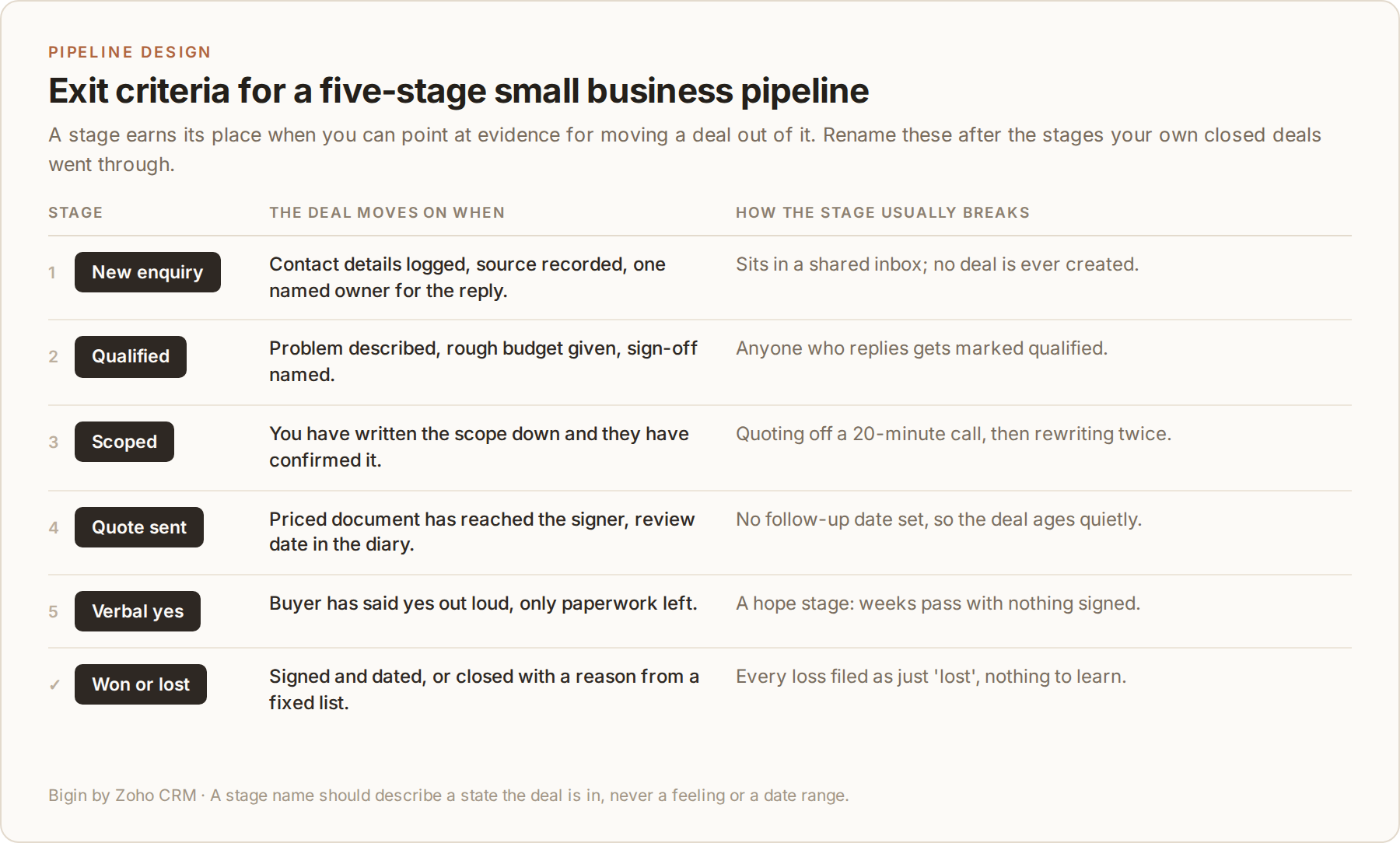
Two things change once the criteria are written down. Deals stop drifting forward on optimism, which makes your forecast less flattering and a great deal more useful. And when a deal does get stuck, you can see exactly which piece of evidence is missing, so the next action writes itself.
Step four: work out how big the pipeline needs to be
Most people build the stages and stop there. Then, three months in, they wonder why the pipeline looks busy while revenue sits still.
Work backward from the number you need. Say you want $240,000 of new business over the next 12 months, and your average deal is worth $8,000. That is 30 deals. If you win one quote in four, you need 120 quotes out of the door. If half your qualified conversations reach a quote, that is 240 qualified conversations. If one in three qualifies, you need roughly 720 inquiries across the year, or 60 a month.
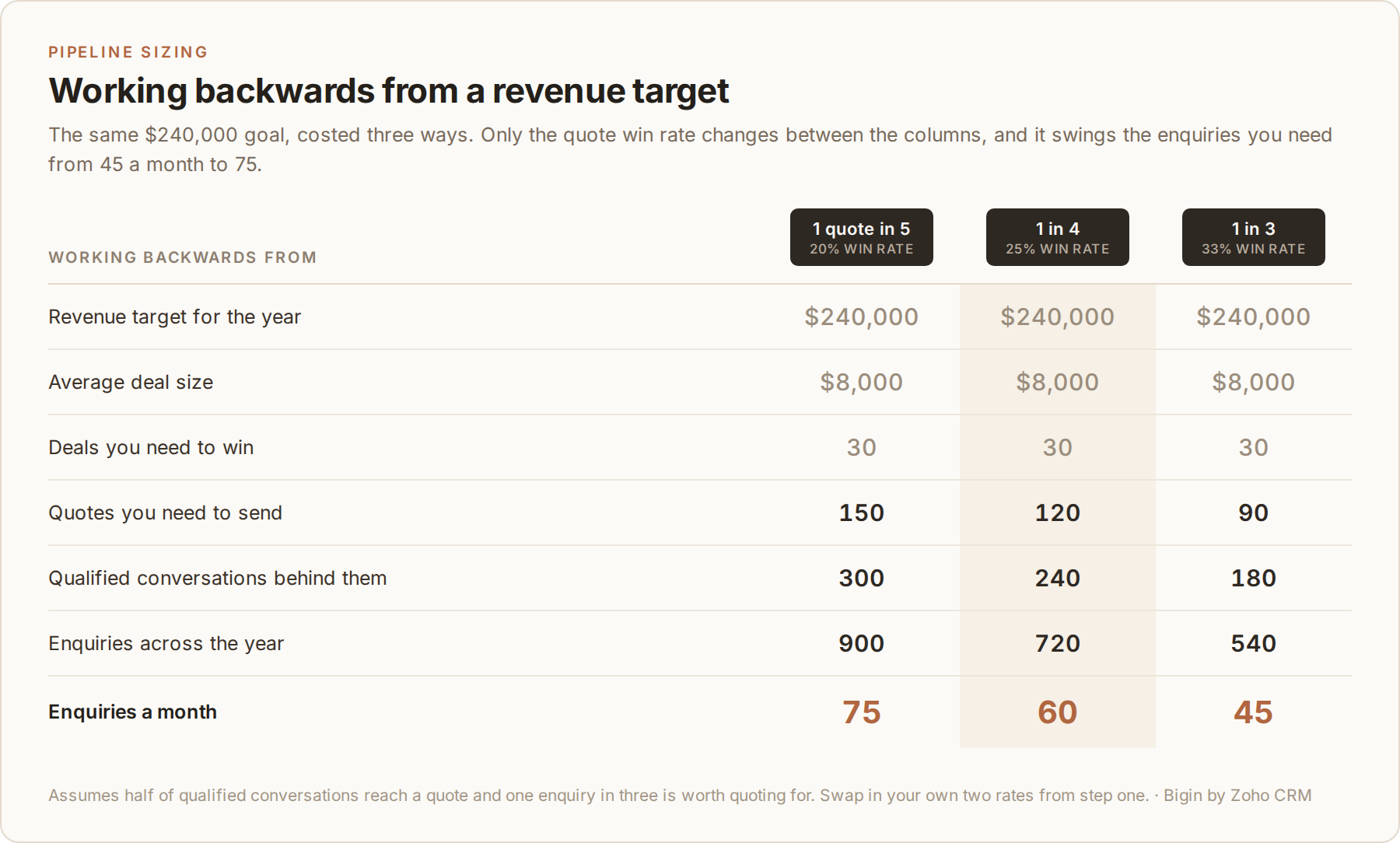
Run that on your own figures, and one of two things happens. Either the top number looks reachable, in which case you now have a monthly inquiry target instead of a vague ambition. Or it looks absurd, which is useful information arriving 11 months earlier than it normally would. The answer is rarely to work harder. It is a larger average deal, a better win rate, or a decision to stop selling the thing that generates 40 inquiries and two customers.
You will see the coverage rule quoted everywhere: keep three times your target in the open pipeline. That figure is only right if you win about a third of what you quote. Win 20% and three times coverage leaves you short. Win half, and it has you chasing work you do not need. Your own win rate, which step one just handed you, beats any rule of thumb. There is more on keeping a pipeline healthy once it is running if you want the maths in detail.
Step five: fill it, including the awkward first month
A pipeline holding four deals is a to-do list. The build is not finished until there is enough inside it to warrant review.
The quickest source of early deals is not advertising. It is the record of everyone who has already spoken to you. Export the contacts you have emailed in the past 18 months. Pull every quote that went unanswered, going back two years. List the customers who bought once and never returned. In most small businesses, that afternoon produces somewhere between 50 and 300 names, and a good share of those people meant to come back to you and simply forgot.
Then add ongoing sources so that the top of the pipeline never depends on a single channel. Referral requests work far better when they are specific: asking a happy customer, "Who else in your building has this problem?" gets an answer, whereas "let me know if you hear of anyone" gets a nod. Add whatever inbound you can sustain, and whatever outbound you can genuinely do every week rather than in a panic before a quiet month.
One rule at the entry point keeps the pipeline from filling with rubbish: nothing gets created without a named contact, a next step, and a date. An opportunity with no next action is not an opportunity. It is a reminder that you once had a conversation. Worth reading up on how to qualify a lead before you decide what earns a place in there at all.
Step six: put it somewhere it will actually get updated
A spreadsheet makes a perfectly good first pipeline. One seller, fewer than about 30 open deals, a cycle short enough that you carry most of the detail in your head: columns for contact, value, stage, next step, and next step date will do the job at no cost.
It fails at a predictable point. A second person joins, and you start overwriting each other. Or the follow-up dates go unread because nothing reminds you. Or a deal resurfaces after four months, and the history of what was agreed sits in an inbox nobody else can search. That is the moment to move, and it tends to arrive sooner than people expect. More on this here.
What matters in whatever you move to is narrower than the feature lists suggest. You want stages you can rename to match the ones you found in step one; email and calls logged against the deal without anyone having to type them in; a next action that includes a date; and a view showing what has not moved. The rest is a bonus.
Bigin was built for this shape of business, which is why I would point a small team at it. You get pipelines with editable stages, calls, and emails attached to deal records. You also have the option for ready-made pipeline templates if you would rather adjust something than start from an empty screen. The free plan covers a single user, one pipeline, and 500 records, which is enough to run everything in this article and see whether your stages survive contact with real deals. Express, at $7 per user per month billed yearly, adds three pipelines and email integration. Stage transition rules, which block a deal from advancing until the required fields are filled in, are available in Premier for $12. That last one is worth knowing about while you are still designing, because it is how exit criteria move from being a document to being enforced.
Step seven: set the rhythm, and the two rules that keep it honest
Half an hour, same slot every week. Three questions, in this order: what moved and why, what has not moved in 14 days, and what has no next action booked. Anything in that third group gets an action during the meeting or gets closed.
Two rules do most of the cleaning. Give each stage an age limit, say 14 days in "quote sent" for a two-month cycle, and treat anything older as a decision rather than a deal. Chase it properly, move it to a nurture list, or close it. Then require a lost reason drawn from a short fixed list: price, timing, competitor, or no decision. A year of that data will tell you where you are actually losing, which no amount of pipeline theory ever will.
When one pipeline is not enough
Split when the stages differ, not when the products do. Two services that both run inquiry, scope, quote, and signature belong in one pipeline, with a field recording which service it is. Renewals deserve their own, because a renewal skips scoping and starts much closer to the end. So does onboarding, and that is the most common second pipeline I see small teams build, usually right after a customer has fallen through the gap between "signed" and "started".
A rough test: if two motions share more than about two-thirds of their stages, keep them together and use a field to tell them apart.
Four signs your new pipeline is getting something wrong
A new pipeline rarely breaks in an obvious way. It tends to get opened a little less each week until nobody is really looking at it. The end of the first quarter is a good moment to check on yours. Finding one or two of these is normal, and none of them takes long to put right.
Most of your deals sit in the middle
When 80% of what is open has collected in the middle two stages, the exit criteria are too loose at the front and too strict at the back. Deals are getting in without being qualified, then piling up against a bar nobody can clear. Raise the entry test and look closely at whichever criterion has become a bottleneck.
The pipeline is more elaborate than the team
Nine stages designed around the salespeople you plan to hire next year will not get updated by the two people you have today. If you keep dragging deals across two stages at a time, you end up with more stages than the business currently needs. Merge the ones that always move together.
The stage names are still the ones the software came with
Every CRM ships with a generic set, and they were written with nobody's business in mind. If yours still reads prospecting, qualification, proposal, negotiation, it describes a company that is not yours, and your team will keep the real status of each deal in their heads. Rename the stages after the moments you found in step one.
Nothing about it has changed in a year
The stages that fit at five deals a month will not fit at 30. If your conversion rates have drifted and the stage list has not moved, read your last 20 closed deals again and check whether the shape still matches.
What good practice looks like
Formal sales process beats improvisation, and it has been doing so for a while. Jason Jordan and Robert Kelly reported as much in Harvard Business Review back in January 2015, drawing on survey work from Vantage Point Performance and the Sales Management Association: businesses with a defined process and disciplined pipeline management grew faster than those without. The percentages from that study get quoted everywhere, usually without the year attached, and the study itself sits behind a paywall. The direction of the finding is the part that has held up.
You will know your own build is finished when the Monday review takes 20 minutes instead of an hour, and when someone else on the team can look at a deal and say what happens next without asking you.
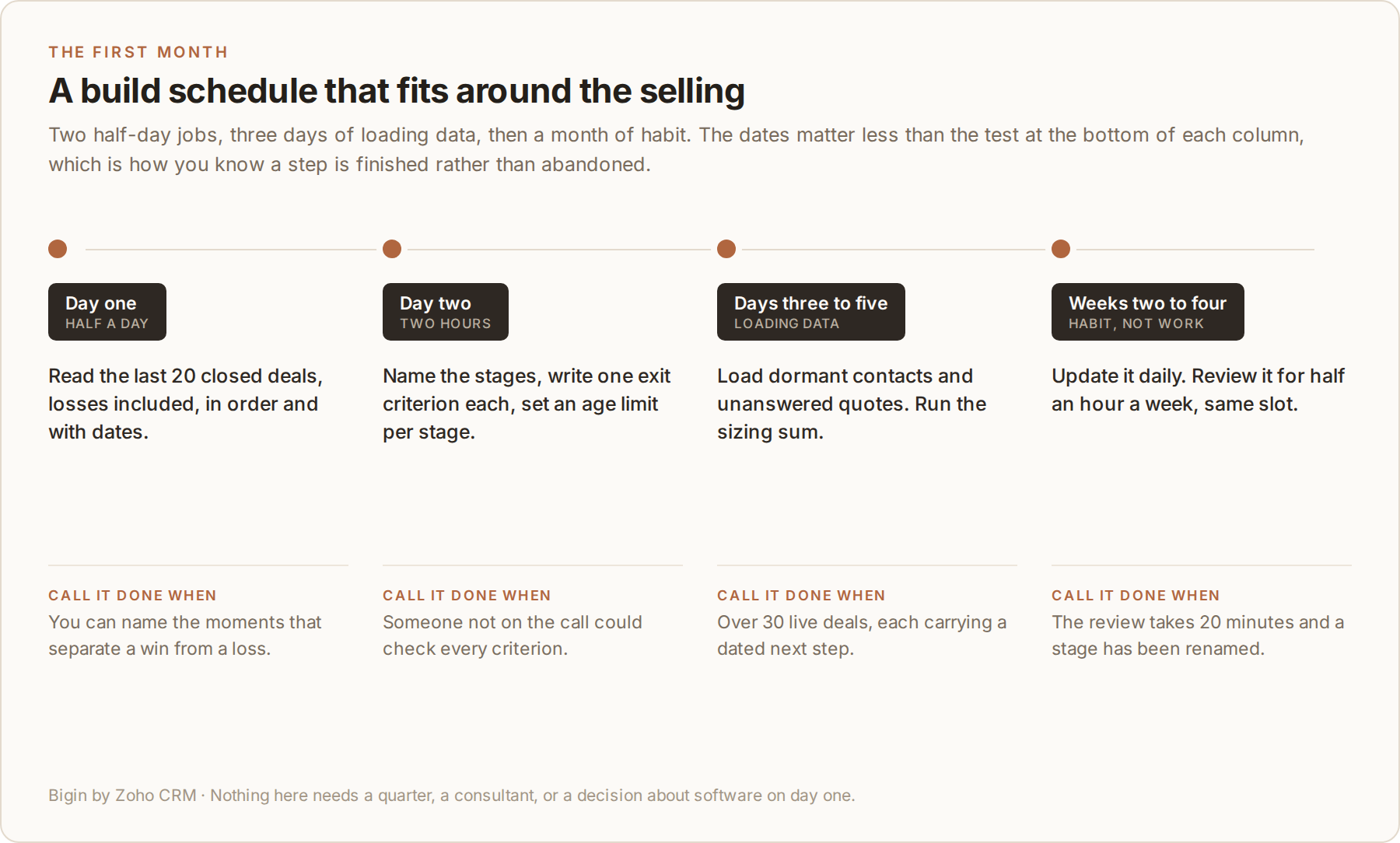
Expect a fortnight of real work: an afternoon reading old deals, an hour naming stages and writing exit criteria, a day getting contacts loaded, then three or four weeks of updating it before the numbers start to mean anything. The stages you choose first will be wrong in one or two places. You will find out which by the end of the first month, and fixing them takes 10 minutes.
Questions people ask when building a first pipeline
Sales pipeline examples: what one looks like in practice
Two, deliberately different. A two-van heating company takes about 60 inquiries a month, closes jobs worth around $3,000, and needs 10 days from first call to signature. Four stages cover it: inquiry, site visit booked, quote sent, won or lost. A software reseller selling $40,000 contracts over four months to two decision makers needs more than that. It wants a scoping stage, because the quote is wrong without one, and a verbal yes stage, because procurement takes three weeks after the buyer has already agreed. Same principle, different count. Your sales cycle and the number of people who have to say yes determine how many stages you need.
How many stages should a sales pipeline have?
Four to six suits most small businesses, and the limit is data, not taste. Each stage needs enough deals passing through it for its conversion rate to mean anything. A business closing 60 deals a year across 10 stages is reading six deals per stage, which will not tell you anything you can act on. Add a stage only when a real decision happens there that no existing stage already captures.
Should I start from a sales pipeline template?
As scaffolding, yes. As a finished pipeline, no. A template gives you something to edit instead of a blank screen, which is worth having on the first afternoon, but it cannot know that your deals live or die on the site visit. Bigin includes pre-built pipeline templates on every plan, the free one included, and renaming a stage takes seconds. Give it a week of real deals, then change the names to the ones you found reading your closed deals.
Can I build a sales pipeline from scratch in Excel or Google Sheets?
Yes, and for a single seller, it is often the right first move. Five columns do the job: contact, deal value, stage, next step, and the date that the next step is due. Sort by that last column every Monday. The sheet stops working the moment a second person needs to update it, or the moment follow-up dates go unread because nothing is reminding you.
What is the difference between a sales pipeline and a sales funnel?
A pipeline tracks individual deals: who owns each one, what it is worth, which stage it is in, and when it should close. A funnel tracks the same journey in aggregate: how many of last quarter's inquiries turned into quotes, and how many quotes turned into customers. Use the pipeline to decide what to do today. Use the funnel to work out which stage is leaking.
Is building a pipeline the same as sales pipeline management?
No, and it helps to keep them apart. Building is a one-off job of about a fortnight that settles your stages, your exit criteria and the size the pipeline needs to be. Management is 30 minutes a week, forever: chasing what has stalled, closing what is dead, and keeping the data clean enough to forecast from.
--
Edited by Anubhav Sarker | Images on this article are AI generated. Please verify thoroughly before using