- Annet Mathews
- Published: 02/19/2026
- Last Updated: 08/25/2026
If you have four salespeople, a CRM, and a manager who runs training on Friday afternoons, most of that list cannot be measured at your company, and a few items on it would mislead you if they could.
Disclosure before we go further: Bigin is our product, a CRM built for small businesses, and it comes up near the end. Everything before that is useful, even if you never open it.
What sales enablement KPIs are, and how they differ from sales metrics
Sales enablement is the work of making salespeople better at selling. Onboarding, coaching, the collateral they send, and the process they are meant to follow. Sales enablement KPIs are the small set of measurements you use to judge whether that work changed anything.
People ask about the difference between metrics and KPIs, and it is worth being precise. A metric is any number you can pull. A KPI is a metric you have attached a target and a decision to. Training completion is a metric. If you have decided that below 90% completion, you postpone the launch, and it becomes a KPI. Most enablement dashboards are full of metrics wearing KPI clothing: they report every month, and nobody does anything differently because of them.
A second distinction matters more. Some numbers indicate what your reps did, such as calls logged, modules completed, and proposals sent. Others describe what happened to the business, like win rate, cycle length, and revenue. Enablement sits between the two. You control the first set, and you influence the second, and confusing the two is how enablement gets blamed for a bad quarter it had no hand in.
Two mistakes worth clearing out first
Gartner has been direct about the first one. Its research found that more than two-thirds of sales enablement leaders measure their impact using pipeline conversion rates, while enablement has little to no direct effect on pipeline conversion. Gartner made the same point when it forecast in February 2023 that enablement budgets would rise by 50% within five years: the metrics the function reports on are often driven by forces it does not control. The most commonly reported enablement KPI, in other words, is one that enablement cannot move on its own.
The second mistake is measuring attendance. Training completion, content views, and a happy survey after a session. Those describe an event in a room. They say nothing about the next deal. If you are going to track one enablement number, make it one that reflects behavior within live deals.
The problem nobody writing about this mentions: your sample is too small
Say you close 60 opportunities in a quarter and win 15. A 25% win rate. You run a training program, and next quarter you win 18 of 60. That is 30%, a five-point gain. Time to write the internal memo?
Not yet. At 25% across 60 tries, the standard error on that rate is about 5.6 percentage points, which puts a rough 95% range somewhere between 14% and 36%. The 30% quarter sits comfortably inside the noise of the 25% quarter. Compare the two properly, and the gap between them is smaller than the margin of error on the gap.
Run the standard sample size calculation, and it gets starker. To detect a real move from 25% to 30% with 95% confidence and 80% power, you need on the order of 1,200 closed opportunities in each period. To detect a jump from 25% to 35%, roughly 325. Those are textbook calculations rather than opinions, and you are welcome to check them. What they mean is that a business closing 60 deals a quarter can never prove a five-point improvement in win rate from one quarter of data. Not with a better dashboard, not with a better platform.
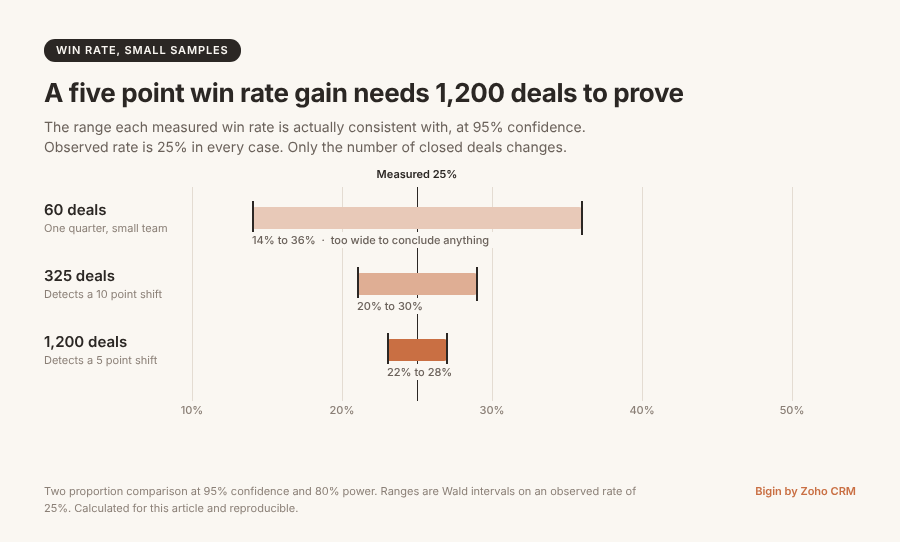
This is the arithmetic every article on this topic leaves out, and for a team of five, it is the finding that changes what you do on Monday. There are ways around it. Pool time, comparing four rolling quarters against the previous four instead of quarter against quarter. Count instead of rating where you can, because "we lost nine deals at proposal last quarter and four this quarter" is a smaller, more checkable claim than a win rate shift. And lean on behavior numbers, which pile up fast. Every rep produces behavior data every week. Only a handful of deals close.
The KPIs worth tracking when your team is under 20 people
Ramp time, and time to first deal
Ramp time is the gap between a rep's start date and the first month they hit target. Time to first deal is the cruder version and easier to pull: the date of hire to the date of the first closed win.
The published benchmark is worth knowing and worth distrusting. The Bridge Group's 2026 research, its tenth biennial study of the account executive role, drew on 158 B2B companies and found the ramp had reached 6.2 months, the longest in the history of that dataset, alongside average required experience at hire rising to 3.7 years. Useful context, with a large caveat: those companies carry a median annual quota of $960,000. If your average deal is worth a few thousand, six months tells you nothing except that ramp always takes longer than the person who did the hiring expects. Track your own for three or four hires, and you will have a house number that beats any benchmark.
Target attainment
The share of reps who hit their number in a period. Simple to calculate, and routinely misreported.
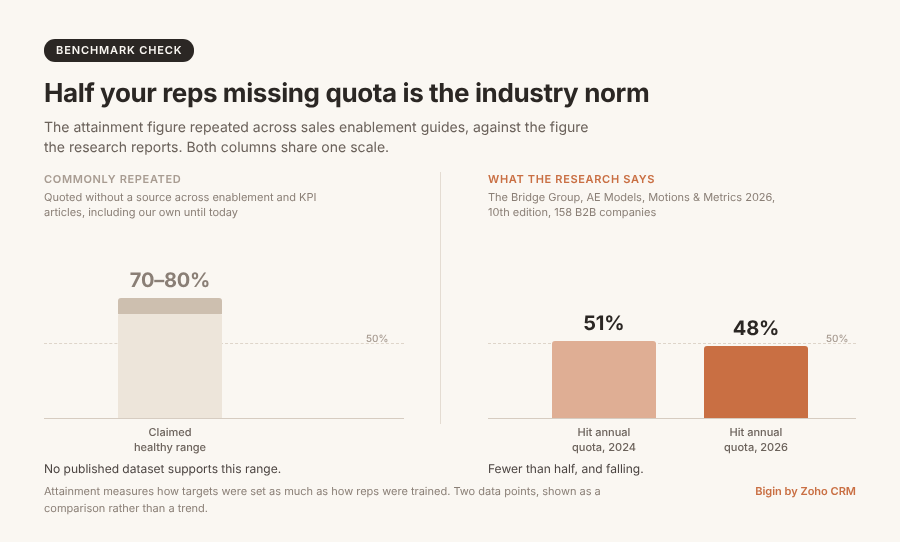
You will read that healthy teams run 70% to 80% attainment. The published data says otherwise. The Bridge Group found 48% of reps achieved annual quota in 2026, down from 51% in 2024, with more companies falling into the band where under 30% of reps make quota. So if half your team is hitting target, you are ordinary, and if a quarter is, the problem may sit in how the targets were set rather than in how the reps were trained. Attainment measures the quota as much as the seller.
Sales cycle length, measured as a median
Use the median, not the average. One 14-month deal from a customer who took a year to sign off will drag a mean badly at low volume, and small teams live at low volume. Then split it by stage, because "our cycle is 74 days" is unactionable, while "deals sit 31 days between demo and proposal" points at a specific week of somebody's job.
Stage adherence
This is the behavior KPI, and the one most likely to predict next quarter. Write an exit rule for each pipeline stage, then measure the share of open deals that meet the rule for the stage they are sitting in. If "proposal" means the customer has seen a number, then a deal parked in proposal with no number sent is not in proposal. Adherence is measurable weekly across every open deal, which sidesteps the sample size problem entirely.
Coaching coverage
The cheapest KPI here, and probably the most useful. Measure the share of reps who had at least one call or deal reviewed with their manager this month. Target 100%.
The reason to bother: Salesforce's State of Sales, seventh edition, published in February 2026 from a survey of 4,050 sales professionals, found 46% of sellers rarely get feedback on their sales conversations, and 47% say they do not get enough roleplay before customer calls. Asked what blocks effective enablement, the youngest cohort named lack of manager time first. Coaching coverage costs an hour a week and has no license fee.
Selling time
The same Salesforce research puts average selling time at 40% of a seller's week, with the most junior reps down at 35%, losing around two hours a week to manual data entry that senior reps spend on research and relationships.
Two warnings about this number. Plenty of 2026 articles still quote 28% to 30%, which came from an earlier edition of the same report, so check which edition you are citing. And the popular claim that 72% of sellers are overwhelmed by their tools misreads the source: Gartner's September 2024 release, based on 1,026 B2B sellers, reported that 72% feel overwhelmed by the number of skills their jobs require and 50% by the amount of technology they use. Both groups are 45% less likely to make quota. The tool's figure is 50%. That distinction matters when your proposed fix for an enablement problem is another piece of software.
The popular KPIs a small team should dro
Every guide on this subject adds metrics. None of them subtracts, so here is the subtraction.
Customer acquisition cost is a finance responsibility, not enablement's. It moves when you change ad spend, and attributing a change in it to last month's objection handling session is not analysis. Customer lifetime value has the same problem, plus a worse one: at a small scale, it is a forecast dressed as a measurement and is highly sensitive to which three accounts are renewed. Churn and customer satisfaction are worth tracking as a business, but they answer questions about your product and your service team, and reading them as a verdict on sales training will lead you to fix the wrong thing.
Training completion can stay on a spreadsheet as a checkbox. It should never appear on the dashboard you show your leadership, because a room full of 100% completion figures is how enablement functions get defunded the first time revenue dips. Content view counts are the same, with the added problem that you probably cannot measure them accurately anyway.
Cut activity totals, too, or at least demote them. Calls made and emails sent tell you a rep was busy. Salesforce's 2026 research found sellers spending 40% of their week on selling, which means the other 60% generates plenty of activity data and very little signal.
What you cannot measure without an enablement platform
Content KPIs are the backbone of every vendor guide on this topic, and for a small business, they are largely fiction. Knowing that a prospect opened your deck, spent 40 seconds on slide four, and forwarded it to a colleague requires a content platform, which means Highspot, Seismic, Showpad, Mindtickle, or similar, priced for companies with an enablement headcount. A CRM will not tell you this. Neither will a shared drive.
Pretending otherwise produces the worst outcome: a content usage number nobody trusts. The honest workaround is manual and adequate: at 40 closed deals a quarter, you can read them. Note in each deal record which one or two assets were sent, then count at quarter end. You will learn which case study appears in wins, which pricing sheet appears in losses, and which four documents nobody has touched since the rebrand. Delete those. Content that has not been sent in two quarters is not an asset.
Training records are the same story. Without a learning platform, a spreadsheet with names, dates, and a short assessment score does the job for a team of eight.
How to prove ROI when you have no control group
This is the question sitting behind the whole topic, and the honest answer is that you cannot prove it cleanly. There is no holdout group. You are not going to run half your five reps without the new onboarding just to have something to compare against.
What you can do is state the number and state what else could explain it. Write down four measures before the program starts, measure the same four 90 days later, and list everything else that changed in that window: a seasonally strong quarter, a price increase, the rep who quit in week three, and the one large account that closed for reasons having nothing to do with training. Then present the movement with that list attached.
Do this before somebody else does it for you. The person who says "win rate is up 5 points, and two of those points are probably the pricing change" keeps their budget in the quarter, but the numbers go the wrong way. The person who claimed all five points does not.
Keep the set to four or five KPIs. A review meeting with 12 numbers on the wall produces no decisions, and the ones that get dropped are always the slow, honest ones.
Tracking these in a CRM you already pay for
Most of what a small team needs sits inside its CRM, because attainment, cycle length, stage adherence, and win counts are all just deal records read carefully.
In Bigin, dashboards take charts and KPI components you can size and share, and goal meters show progress against a target as a dial, a traffic light, or bars. Three dashboards ship prebuilt, covering call analytics, email analytics, and calls by user, which handles the activity layer without setup. Pipeline views give you stage distribution at a glance. The free plan covers one user with 500 records and three automations, and Express runs $7 per user per month on annual billing as of August 2026, so the measurement layer costs roughly nothing.
The limits, plainly. Bigin does not track content engagement, does not score calls, and holds no training records, so coaching coverage and ramp time need a custom field or a spreadsheet, and custom fields are capped by plan. Deeper analysis means the Zoho Analytics connector, which is a separate paid subscription. If your enablement program is built on formal courses and a managed content library, you want a real enablement platform and not a CRM dashboard.
One more piece of honesty, since it bears directly on everything above. Our customer stories carry figures like a 30% lift in conversion rates and 20% more deals closed. Those are the customers' own numbers, one company each, no baseline published, and no control group. Read them as stories, which they are. Do not read them as benchmarks because a single company's before-and-after is exactly the kind of evidence this article has been telling you to treat carefully.
Where to start
Pick four: ramp time, target attainment, median cycle length by stage, and coaching coverage. Write today's value for each next to today's date, even if the value is a guess flagged as a guess. Set a rule about when you are allowed to draw a conclusion, and make it generous because the sample size arithmetic above is not going to bend for you.
Then leave it alone for two quarters. The Bridge Group's number for how long a new rep takes to reach full productivity is 6.2 months. Your enablement program deserves at least as long before you judge it.
---
Edited by Anubhav Sarker | Images on this article are AI generated. Please verify thoroughly before using.
Sources
- The Bridge Group, AE Models, Motions & Metrics: 2026 Research Report (10th ed.), June 23, 2026 — https://blog.bridgegroupinc.com/2026-ae-compensation-quota-ai-metrics
- Salesforce, State of Sales, 7th edition, February 3, 2026 — https://www.salesforce.com/news/stories/state-of-sales-report-announcement-2026/
- Gartner, "Does your sales enablement program measure impact?" — https://www.gartner.com/en/sales/trends/sales-enablement-metrics
- Gartner, "Gartner Expects Sales Enablement Budgets to Increase by 50% by 2027," February 15, 2023 — https://www.gartner.com/en/newsroom/press-releases/2023-02-15-gartner-expects-sales-enablement-budgets-to-increase-by-50-percent-by-2027
- Gartner, "Gartner Sales Survey Reveals Sellers Who Partner With AI Are 3.7 Times More Likely to Meet Quota," September 16, 2024 — https://www.gartner.com/en/newsroom/press-releases/2024-09-16-gartner-sales-survey-reveals-sellers-who-partner-with-ai-re-three-point-seven-times-more-likely-to-meet-quota
- Bigin by Zoho CRM, Dashboards — https://www.bigin.com/features/dashboards.html
- Bigin by Zoho CRM, Pricing — https://www.bigin.com/pricing.html
- Zoho Analytics, Advanced Analytics for Bigin connector documentation — https://www.zoho.com/analytics/help/connectors/bigin.html