- Farah Naseem
- Published: 12/11/2025
- Last Updated: 09/23/2026
This article sticks to one question: you have a target for the month or the quarter, so what does the software need to do for you? It covers what to look for, when a CRM is enough, and when a dedicated planning tool is worth paying for.
What sales planning software is for
Sales planning software is any tool that helps you turn a target into decisions. How much business do we need? Where will it come from? Who owns each piece? What has to happen, and by when? Some products do the math for you. Others just hold the records and leave the math to you. Four words get mixed up here. One example sorts them out.
Say a small commercial cleaning company wants $300,000 in new contracts next quarter. The sales plan is what you intend to happen and what you are assuming: $300,000, three salespeople, a 25% win rate, and four new qualified opportunities a week.
The sales pipeline is what the team is working on right now: 24 open opportunities, each with a stage, a value, and an expected decision date.
The sales forecast is your best estimate of what those 24 will produce: about $120,000.
The software is whatever holds all three and lets you compare them every week. If the forecast is short of the plan, the plan needs new actions or new assumptions. If the pipeline cannot support the forecast, the forecast is wishful thinking. That comparison is the whole job. A chart of last month's revenue is reported. It is useful, but it only becomes planning when the target sits next to it, and you can see the gap.
Two products share the name
The first is dedicated planning software, built for sales operations teams at bigger companies. G2's category definition, read September 23, 2026, expects territory carving, quota allocation, capacity management, what-if scenarios, and continuous replanning. The products it lists are Anaplan, Xactly, Varicent, Pigment, and CaptivateIQ. Salesforce sells a Sales Planning module as an add-on at $75 per user per month, billed annually. These tools answer questions like "if we hire two reps in March, how much quota can we give them in Q3?"
The second is the CRM itself. That is where most teams under 20 people plan, whether they call it planning or not. The CRM has the pipeline, the owners, the close dates, and usually a dashboard where a target can sit next to the total. It lacks the modeling layer. It will not redistribute quota when someone leaves, model a new hire, or tell you a territory is overloaded.
A CRM is usually enough when one manager knows every open deal, accounts are assigned by simple rules, quotas are set by hand once a year, and the plan lives in a meeting rather than in a system for finance audits. You have outgrown it when people rebuild the same spreadsheet every planning cycle, when quota arguments are about territory fairness, when you are modeling hires before committing to them, or when a compensation plan needs numbers the CRM cannot produce. Xactly's guide to sales planning puts the relationship simply: planning sets the targets, forecasting tracks progress toward them, and if the forecast keeps missing the plan, the plan needs to change.
If you are still choosing the CRM, the sales CRM software for small businesses guide covers that. This article assumes you have one.
What a small team needs the software to do
Planning fails due to missing basics far more often than due to missing advanced features.
Planning need | What to look for | What to check in a trial |
|---|---|---|
Target and actuals are measured the same way | A goal component next to a closed-won total for the same period | Enter a target, close a test deal, and confirm that both use the same field and dates |
A pipeline you can trust | Owner, stage, value, and expected close date on every deal | Try saving a deal with no close date, then check whether you can make the field required |
Views by person, product, or group | Saved views filtered by owner, product, tag, or region | Build one view per salesperson and one for deals closing this month |
Assumptions and scenarios | Somewhere to hold win rate, cycle length, and capacity, and compare two versions | If this lives in a spreadsheet next to the CRM, note where it is and who updates it |
Data from where it already sits | CSV import, billing or marketing integrations, and an automation connector | Import a real file and check the dates survive |
Ownership and change control | Roles that limit who edits targets, an audit trail, and clean exports | Ask who can change a target mid-quarter and whether it is logged |
Cost of running it | Admin time to keep stages and fields current | Estimate hours per month, not just the license |
The gap between the first row and the fourth matters most. Many CRMs give you a target meter. Few give you the model. Treat "supports forecasting" as a claim to test, because it sometimes just means the software shows stage totals. That helps, but it is not a model.
One quarter, one team, in round numbers
Everything here is illustrative. The figures are round, so the logic is easy to follow. Your win rate, deal size, and cycle length will differ.
Picture a commercial cleaning company. The owner runs sales with three salespeople. They sell annual service contracts to offices and clinics, and they count a sale when the contract is signed. That is a bookings basis: signed first-year contract value, not revenue recognized month by month, and not cash collected. Pick the basis first. The most common planning error is a bookings target checked against a report built from invoices.
Step one: the target. $300,000 in new bookings for the fourth quarter, October 1 to December 31, 13 weeks.
Step two: what is already won. The owner plans to do so in the first week of October. Two contracts signed on October 1 and 3 are worth $40,000 together. The remaining gap is $260,000.
Step three: the current pipeline. 30 opportunities are open, but only 24 have expected decision dates inside the quarter. Those 24 are worth $480,000, so about $20,000 each. Over the last four quarters, the team won 25% of qualified opportunities, counting deals won divided by deals won plus lost. So 24 × 25% gives six expected wins, about $120,000. The other six have January dates and belong to the next quarter.
Step four: what still has to be found. $260,000 minus $120,000 leaves $140,000, or seven more wins at $20,000 each. At a 25% win rate, seven wins need 28 new qualified opportunities. This is an estimate from averages, not a promise. The team might win nine of the next 28, or four.
Step five: timing and capacity. The team's typical cycle from qualification to decision is six weeks. Anything qualified after about November 14 will probably be decided in January. So the 28 have to be found in the first seven weeks: four a week. Each salesperson has historically qualified one to two a week while working existing deals, so three people can manage three to six. Four is inside that range, but with no room for a slow week. Better to know that in week one than in week ten.
Step six: owners and dated actions. Each salesperson owns their opportunities and their decision dates. The eight largest open deals, worth $240,000 between them, will get a scheduled next step with the customer by October 10. The owner pulls the last two quarters' lost and no-decision deals by October 17 to see which can be reopened, and takes over inbound website requests so the salespeople can focus on qualifying. The team reviews the numbers every Monday.
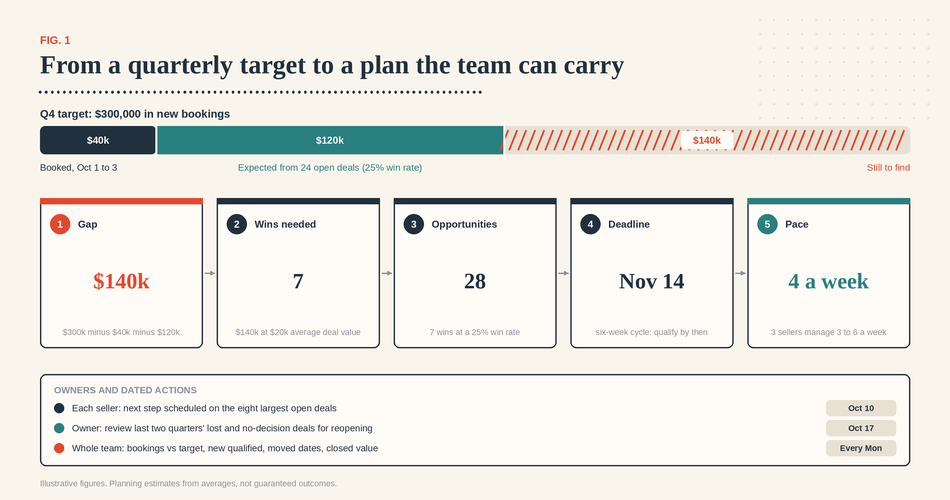
Fig. 1. The target is split into booked, expected, and still-to-find, followed by the five steps from gap to weekly pace.
Step seven, the adjustment, gets its own section because it is where most plans quietly die.
When results fall behind
It is mid-November, the week six review. The team has booked $120,000 in total, including the original $40,000. Two things have changed. The largest open deal, a $40,000 contract expected to be signed on November 15, has been moved to January because the customer's board meets quarterly. And of the ten new opportunities decided so far, two were won. That is 20%, not 25%.
These are two different kinds of change. The slipped deal is a timing problem. It is not lost, it has left the quarter. Take it out, and 29 opportunities are still undecided in Q4, worth about $560,000. At the historical 25%, that is about seven wins, roughly $140,000, for a forecast of $260,000 against a $300,000 target. The gap is the slipped deal, more or less.
The lower win rate is an assumption problem. Ten decisions are a small sample. If it holds, the same 29 opportunities produce closer to six wins and a forecast near $240,000. In both versions, the target has not moved. Only the timing and the assumptions have. Write both versions down.
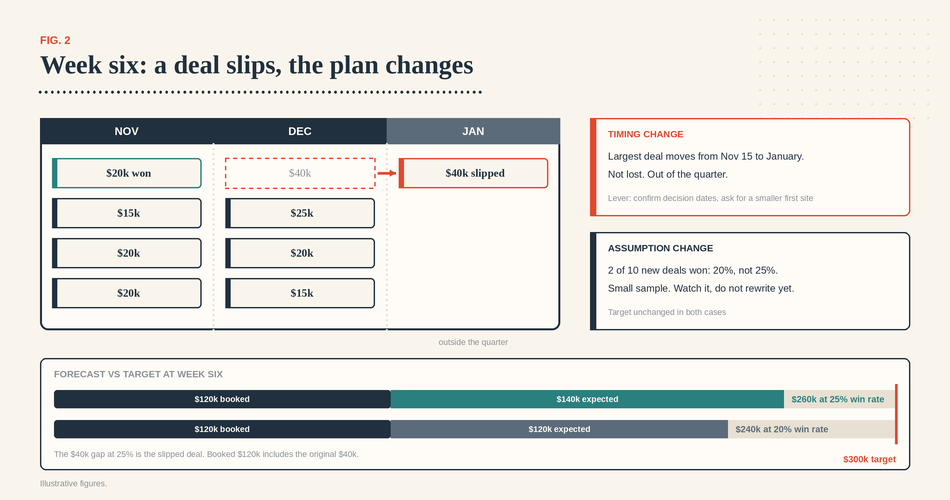
A shortfall comes from one of five places: too few opportunities, too few of them converting, decisions arriving late, deals smaller than assumed, or not enough selling time. Each has a different fix. Here, more new opportunities do not help, because anything qualified after mid-November is decided in January. The levers left are timing and deal size. So the eight largest open deals each get a decision date confirmed with the buyer before Thanksgiving week, and the salesperson on the slipped contract asks whether a smaller first site could sign in December. Qualifying continues, but those new opportunities go into the first-quarter plan, not this one.
Every week, look at four things: bookings against target, opportunities qualified that week, decision dates that moved, and the value of what closed. Revisit the plan itself monthly or quarterly when the win rate stays off its usual level for six weeks or more, deal size shifts, a salesperson leaves, or opportunities start coming from a new source. The guide to tracking sales goals goes deeper into the weekly review. Resist the two reflex answers. "Raise activity" only works when there are too few opportunities, and there is still time to close them. "Lower the target" is sometimes right, but make it a dated decision with a reason. Do not let the forecast quietly become the plan.
What it costs, and whether free is enough
For a team of three to five, the license is rarely the highest cost. The hours spent keeping records current are.
Free CRM plans usually allow one or a few users, with limits on records, pipelines, and fields. They suit one person planning their own quarter, and rarely a team, because views-per-person and a target next to actuals tend to sit on paid tiers. Bigin's free plan, for example, allows one user, 500 records, and one team pipeline. It includes standard dashboards but not custom dashboards or target meters, per its feature availability page, as of September 23, 2026. Check any free tier for a target next to actuals and filters by owner.
A 14- or 15-day trial usually unlocks all features. Use it to run the worked example above. Load 20 real opportunities with owners and dates, and enter a target on your basis. Move one decision date into the next quarter and watch what the total does. Change your assumed win rate and see whether anything recalculates, or whether you are back in a spreadsheet. If the trial cannot show you the gap between plan and forecast for one period, a contract will not either.
Dedicated planning software is priced differently. Salesforce's module is a per-user add-on. Enterprise platforms are quoted by contract and assume a sales operations person to run them. That cost is justified when the questions about territory, quota, and headcount are real. Most teams under 20 are not yet.
A small team that planned inside its CRM
Premier Chess Academy is a US-registered online chess coaching business, run remotely by its two co-founders. It started on spreadsheets and WhatsApp and moved its sales team onto Bigin. According to its published customer story, the trial-to-conversion process runs on a Kanban board; coaches see only their own students via roles and permissions; and co-founder Deepak Subramani uses dashboards to monitor revenue, trial accounts, conversion rates between trial and paid classes, and daily incoming leads. Those are the same inputs as the diagnosis above.
The company reports that it has since supported a team five times larger and ten times the lead volume without manual errors. Those are customer-reported figures. The story does not claim that the forecasts became more accurate; it claims that the team could see what was happening. As Subramani put it: "Bigin is a super simple to use and delivers fantastic visibility across the organization on what is happening!"
Setting up a simple sales plan in Bigin
If the cleaning company ran its plan in Bigin, the deals would sit in a team pipeline for new contracts. Each one carries an owner, a stage, an amount, and a closing date. The 24 in-quarter opportunities are a list view filtered on closing date, saved for the Monday review. One view per salesperson covers ownership. Stage transition rules on Premier and Bigin 360 may require a closing date before a deal leaves qualification.
The target sits on a dashboard. Bigin's dashboards show the total value in each stage, and target meters let you set a goal and track progress as a gauge or bar. Custom dashboards need Express or above. Target meters need Premier or Bigin 360, per the feature availability page.
Two things Bigin does not do natively: it has no forecasting module, and no quota, territory, or capacity planning. The win-rate math, the 28-opportunity estimate, and the two revision scenarios are calculations you make outside the product, using the numbers Bigin gives you. Keep them in a note on the plan and update them at the review. Check current pricing and edition limits before deciding.
If you want to try the method, load your open opportunities into a 15-day trial, set one target for the current period, and run the Monday review twice before you decide anything.
--
Edited by Anubhav Sarker | Images on this article are AI generated. Please verify thoroughly before using