- Anubhav Sarker
- Published: 11/18/2026
- Last Updated: 11/18/2026
What happened from November 9 to 17
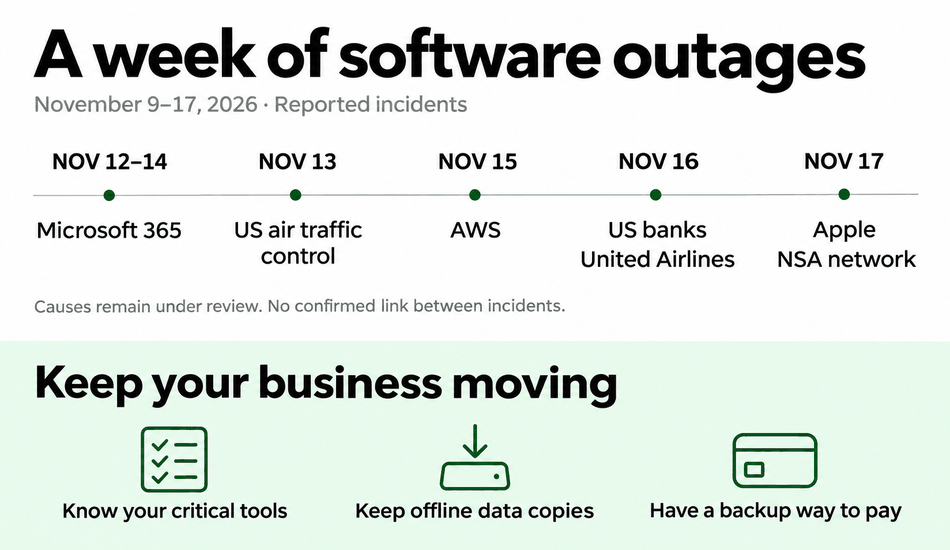
Seven widely used systems failed in six days, and one confirmed attack ran alongside them. Here is the week in order, with the cause each organization has given so far.
Date | What happened | Cause given so far |
|---|---|---|
Nov 10 | Microsoft's monthly security release fixed 1,094 vulnerabilities, after 1,408 in October and 997 in September (The Stack). | This was a scheduled release, with no outage. It matters for the "why" section. |
Nov 12 to 14 | Microsoft 365 failed in more than 70 countries. Outlook, Teams, Exchange Online, and Copilot were affected, and recovery took 24 to 36 hours depending on the source (Wikipedia). | Microsoft's preliminary report: a software defect in its gateway servers surfaced under heavy traffic while capacity was reduced. Microsoft called it "a technical issue not related to cyber or AI/agents" (Yahoo Finance). |
Nov 13 | The FAA stopped departures across the US for more than four hours. Delays ran for days. | Officials traced it to excessive connection requests during a router upgrade. The root cause is still under review (Implicator). |
Nov 15 | AWS experienced sign-in, sign-up, and connectivity failures in its US-EAST-1 region for about three hours (per AWS's health feed). | AWS has not published a cause. |
Nov 16 | Customers at JPMorgan Chase and several other US banks had trouble logging in and moving money, including through Zelle. | Chase: "a software bug in on-premise hardware systems," with "no evidence this is cyber-related" (Yahoo Finance). |
Nov 16 | United Airlines held departures during a system outage. | United said it was unrelated to the FAA ground stop—no cause published (Yahoo Finance). |
Nov 16 | Attackers planted malicious code on the websites of 178 organizations through Optimizely, a website testing tool. The code could swap crypto wallet addresses and skim payment cards (The Record). | Optimizely: an unauthorized party "exploited a vulnerability in Experimentation." It says the flaw is fixed and the code removed (SecurityWeek). |
Nov 17 | Apple's App Store, iCloud, Apple Pay, and Apple Music had problems (9to5Mac). | Apple: the problems began after an internal update and were not a cyberattack. |
Nov 17 | An NSA network used for classified internal communication went down. | The NSA cited scheduled maintenance. Director of National Intelligence Jay Clayton said it failed after a patch for PHP vulnerabilities (Implicator). |
Why so many outages happened in one week
No company or official has said these incidents are connected. Microsoft, Chase, and Apple each said their outages were not cyberattacks. The Optimizely incident is the one confirmed attack.
That is the verified part. What follows is my reading of the public statements.
Most of the stated causes involve a change. The FAA was upgrading a router. Apple pushed an internal update. The NSA was doing maintenance. Microsoft's defect stemmed from a server change that began rolling out in July and failed only under load on November 12. Software is at its most fragile right after someone touches it.
Shared systems spread the damage. About 430 million people use Microsoft 365, so one fault reached hospitals, schools, and government offices at the same time. Optimizely shows the same thing on the security side: a single compromised script affected 178 organizations.
Then there is the AI theory, which is unproven. Security teams are patching at record volume, and Microsoft's 1,094 fixes on November 10 followed 1,408 in October. The Washington Sun reported, citing three anonymous sources, that bank executives and NSA officials told Congress the rush to patch AI-found flaws drove the outages. On the record, Clayton tied the NSA failure to a patch.
The pushback is also on the record. FAA administrator Bryan Bedford said there was "zero evidence of anything AI-related." Christiaan Beek of Rapid7 said nothing public suggests the outages came from rushed security updates (Implicator). My view: the theory fits the NSA case and is unproven for the rest.
Big outages are also more common than this week made them feel. A Control Plane tracker counted 19 major outages across AWS, Microsoft Azure, Google Cloud, and Cloudflare through November 16, 2026, according to Business Standard. This week stood out because the failures landed close together and hit tools people use every day.
What small businesses can do right now?
You can do all of this without a security team or a big budget. Each step maps to something that failed this week.
- Write down the handful of tools your business stops without: email, payments, your CRM, your phone system. Next to each, note how you would get through a day without it.
- Keep an offline copy of what you need to keep working. Export your customer contacts and open deals once a week, and save important phone numbers somewhere outside your email.
- Set up a second way to pay and get paid. The banking problems on November 16 delayed transfers, so leave a few days of slack before payroll and supplier deadlines.
- Bookmark the status pages of your main vendors and subscribe to their alerts. When something breaks, check there first. It saves an hour of time by not restarting your router.
- Keep automatic updates switched on. This week's failures occurred within large providers, and the patches fix flaws that attackers can exploit. Dustin Childs of Trend Micro's Zero Day Initiative advised teams against delaying this month's Microsoft patches (The Stack).
- Turn on multi-factor authentication, and be suspicious of any email offering an urgent fix. After the CrowdStrike outage in July 2024, CISA warned that attackers were exploiting it to conduct phishing (CISA).
- If your website takes payments, check which outside scripts load on your checkout page. A payment processor's hosted payment field sits outside the reach of a skimmer like the one in the Optimizely attack, according to Collin Hogue-Spears of Black Duck (The Record).
How Zoho approaches security and reliability
Bigin is part of Zoho, so I am not neutral here. I will stick to what Zoho publishes so that you can check every line on its security page and trust pages.
No provider can promise zero incidents, and that includes us. A provider can invest in prevention, monitor its systems constantly, and quickly notify customers when something goes wrong.
Zoho has dedicated security and privacy teams. A Network Operations Center team monitors our infrastructure and applications, and that monitoring runs around the clock.
Customer data at rest is encrypted with 256-bit AES, and connections use TLS 1.2 or 1.3. Data in one data center is replicated in another. Databases receive incremental backups daily and full backups weekly, with backups are retained for 3 months.
Outside auditors check this work. Zoho lists ISO 27001, ISO 27017, ISO 27018, and SOC 2 Type II among its certifications. Zoho also runs a bug bounty program for external researchers, holds periodic disaster recovery drills, and commits to notifying customers of incidents that affect them.
Where this leaves a small business
A week like this is unsettling, and feeling uneasy about it is reasonable. Your business runs on software maintained by other people, and this week you watched several of them have a bad day.
The helpful response is small and practical. Know your critical tools, keep a copy of your data, and have a second way to get paid. By my estimate, most of the seven steps above fit into one afternoon.
The picture is still incomplete. Microsoft's final report is due on November 20, and the FAA review is open. Some of the causes listed here may change when those arrive.