- Tamanna Kovoor
- Published: 03/13/2026
- Last Updated: 09/14/2026
Tracking sales goals means comparing completed sales against a defined target, assessing whether your open opportunities can cover the remaining gap, and deciding what to do next. The tracking part is easy. The useful part is connecting each number back to the customer conversations that produced it.
For a small business, the system can stay simple: one agreed definition of a sale, a shared record of every opportunity, a few metrics that matter, and a weekly review. This guide walks through how to build it, using a $40,000 monthly goal as the running example, and ends with a practical setup you can copy in a CRM.
Define exactly what counts toward your sales goal
"Increase sales" gives you a direction. "Win $40,000 in new service contracts this month" gives you something to measure.
Before tracking begins, pin down four things: the amount, the deadline, the owner, and the event that counts as success. For a service business, that event might be a signed agreement. For a retailer, it could be a confirmed order or a payment received.
Then keep that definition still. A signed contract, an invoice, and cash in the account are three different events, often weeks apart, and mixing them is how a business ends up celebrating a record month while the bank balance says otherwise. If your goal measures signed contracts, label the dashboard that way.
Base the target on recent results and the opportunities already underway, then check it against your capacity to deliver. If you normally win $30,000 a month, name what gets you to $40,000: more qualified inquiries, bigger projects, better conversion, or some mix. Write that assumption down somewhere you'll see it again, because in a month you'll want to know whether you were right.
A new business has no history to lean on. Treat the first target as a planning assumption and revisit it after one full sales cycle, once enough deals have finished to teach you something.
Metric | How to calculate it | What does it tell you |
Sales goal attainment | Won sales value divided by target, multiplied by 100 | How much of the goal have you achieved |
Remaining sales gap | Target minus won sales value | How much more do you need to close |
Qualified pipeline coverage | Eligible open pipeline value divided by the remaining sales gap | How much potential business backs the rest of the target |
Win rate | Won deals divided by won plus lost deals, multiplied by 100 | How often completed opportunities become sales |
Overdue follow-ups | Count of open follow-up tasks past their due dates | Which commitments need attention |
Establishing clear sales goals
Measure attainment and the gap over the same period. For pipeline coverage, count only qualified opportunities with a realistic chance of closing inside that period. Once you've hit the target, coverage against the remaining gap stops meaning anything, so don't keep staring at it. Win rate needs one consistent definition of a qualified opportunity, and it needs your losses. Deals that are still open stay out of the calculation because the rate only applies to finished ones. If you've only closed a few deals, show the counts next to the percentage. Two wins from four decisions tells a reader something. An unexplained 50% tells them nothing. Attainment records what has already happened. Pipeline and follow-up numbers hint at what happens next. Add other sales key performance indicators later, when you hit a question this set can't answer.
Aligning goals with the sales process
1. Work backward from the target
Breaking a target into opportunities shows you quickly whether the plan is workable.
Say your monthly goal is $40,000 and your typical contract is $4,000. You need about 10 wins. If you win one in four comparable qualified opportunities, those wins take about 40 qualified opportunities to reach a decision.
These are planning estimates. Deal values vary, conversion rates drift, and the math only holds when the customers, offers, and selling conditions you're comparing are similar.
Timing matters just as much. If customers take six weeks to decide, an inquiry arriving on the 25th is feeding next month's number, not this one. Whatever you close in September was mostly set in motion in August.
Use the calculation to test the target before you split it across the team. Do you have enough opportunities to play? Enough selling hours? Enough delivery capacity if it all lands at once?
If two people share the target, decide who owns what. You might split customer segments, or set individual targets that add up to the team total. A deal you both worked on counts once in the business total. Agree on that before someone wins it, not after.
2. Keep each opportunity in one shared record
A sales goal tracker is only as reliable as the deal records behind its totals. One record per opportunity, linked to the customer.
Capture the deal name, expected value, current stage, owner, expected close date, next action, and next action date. When the deal closes, record the win or loss with the actual close date and, if you can, a loss reason.
Expected and actual close dates do different jobs. One is a plan, and one is history. Reporting that blurs them will quietly flatter your forecasting.
Update the record after any meaningful customer conversation, while you still remember what was said. A revised budget changes the amount. A delayed decision moves the close date. A completed follow-up produces either a next action or an outcome, never a blank.
And make the shared record the place where the team works. The moment someone keeps a private spreadsheet for the Monday meeting, you own two versions of the truth and a standing argument about which one is current.
3. Use stages with clear entry conditions
Pipeline stages should describe observable progress. A simple service business might use Qualified, Discovery completed, Proposal sent, Decision pending, Won, and Lost.
Agree on what has to happen before a deal enters each one. "Proposal sent" means a real proposal has reached the customer. "Decision pending" might mean the customer has told you who decides and roughly when.
Clear definitions make stalls visible. If proposals pile up without confirmed decision dates, the fix is to clarify how these customers buy. If qualified inquiries rarely reach discovery, look at fit, response times, or how hard it is to get a meeting in the calendar.
The temptation is to move forward with a deal because the call went well. Everyone does it. Record what the customer agreed to instead, so that two people reading the same pipeline reach the same conclusion.
4. Compare attainment with the time remaining
An attainment percentage means nothing without a time reference. Being 40% of the way to a monthly goal reads very differently on day 10 than it does on the final afternoon.
If your sales arrive evenly, the reference is simple: Multiply the target by the share of selling days elapsed, using the same working-day calendar every time.
Plenty of businesses don't work that way. If most of your orders land in the last week, build the reference from your own history instead of a straight line, and account for holidays, buying cycles, and the week you close the office. A seasonal pattern you've seen for three years running is not a performance problem, and reporting it as one just teaches your team to ignore the dashboard.
Keep three numbers apart: actual results, the pace reference, and the forecast. The reference says where you planned to be. The forecast is your honest estimate of where you'll land.
5. Check whether the remaining pipeline is credible
A large pipeline total is the easiest number in the business to fool yourself with. It hides stale opportunities, values nobody has updated since the first call, duplicates from a web form, and deals that everyone privately knows slipped into next month. Go and look at the specific ones that would have to close for you to make the goal.
For each: Is the need confirmed? Is the value realistic? Is the buyer still responding? Is the decision date achievable? Is there a next step in the calendar?
There's no universal coverage multiple that makes a pipeline safe. If roughly 25% of the comparable eligible pipeline value typically closes within the period, then about 4 times the remaining gap is a workable planning reference. Note that the assumption is about value. Winning 25% of your deals by count does not mean winning 25% of the money, and the difference tends to show up at the worst possible moment.
Concentration matters too. A pipeline resting on one large customer behaves nothing like one spread across a dozen small ones, even when the totals match. Review the big deals individually.
6. Finish every review with assigned actions
A weekly review exists to decide what changes. Spend it on the gap, on the deals most likely to close it, and on any obstacle someone in the room can clear this week.
Every action gets an owner and a date. "Follow up on proposals" is not an action. "Jordan will confirm the decision meeting for the $6,000 proposal by Thursday" is something you can check on Friday.
Open the next review by checking those commitments. When the same item rolls forward three weeks in a row, stop and ask why. The customer may have gone quiet. The proposal may need rework. Sometimes the honest answer is that the deal was never as qualified as it looked, and someone has been carrying it because closing it as lost feels like failure.
When the target looks unlikely, change the forecast and leave the goal alone. Keeping the original visible is how you learn anything from the gap. Quietly editing the target until it matches reality is how you learn nothing.
Look at the quality of the fixes, too. A discount closes the contract and takes the margin with it. An aggressive delivery promise becomes someone else's problem in six weeks. Weigh each action against the customer's needs and what you can profitably deliver, because hitting this month's number at the expense of the relationship is just borrowing from next month.
A worked example of monthly sales goal tracking
Take a service business with a $40,000 monthly target and 20 selling days. After day 10, it has won $16,000 in contracts.
The daily figure is an average, and contracts won't arrive on schedule. It still lands harder than "we're at 40%," which is the kind of sentence a team can nod along to for another week.
Measure | Calculation | Result |
Goal attainment | $16,000 divided by $40,000 | 40% |
Even-pace reference | $40,000 multiplied by 10 out of 20 days | $20,000 |
Gap against that pace | $20,000 minus $16,000 | $4,000 behind |
Sales still needed | $40,000 minus $16,000 | $24,000 |
Required remaining pace | $24,000 divided by 10 selling days | $2,400 per day |
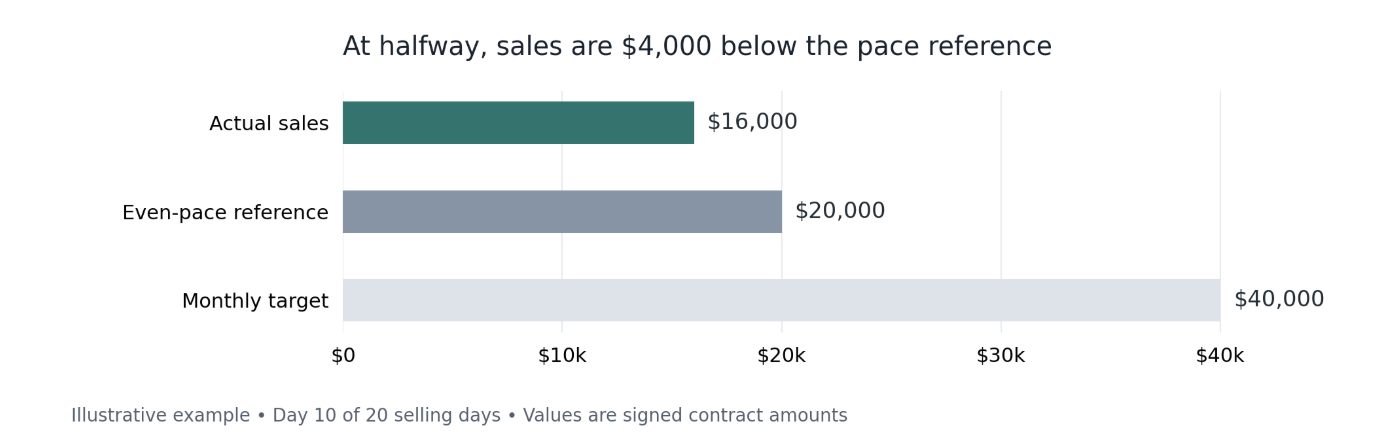
Now suppose there's $72,000 in qualified open opportunities that might close this month. Coverage is three times the $24,000 gap, which sounds comfortable. Apply the 25% value assumption, and the pipeline points to about $18,000 in additional sales, leaving a possible shortfall of $6,000. That's a scenario estimate, not a deal-by-deal forecast, but it's enough to change what the owner does on Monday.
And what they do is open the deals themselves. Maybe two proposals just need a decision meeting on the calendar. Maybe an existing customer has a real expansion opportunity nobody has asked about. Maybe one large deal genuinely belongs next month and should be moved, which would make the gap look worse and the forecast better.
The review ends with named actions and a number you'd be willing to defend. Padding the pipeline with unqualified inquiries would inflate the total, making the problem harder to see.
Build a review routine your team can maintain
Update deal information as the work happens. Before the day ends, every active opportunity should have a current stage, an owner, and a next action.
Review the target and the pipeline weekly. Twenty minutes covers completed sales, the remaining gap, close dates that moved, overdue commitments, and the decisions needed to unblock work. A solo owner runs the same agenda without booking a meeting.
At month-end, go deeper. Compare actual sales with the original target, read the losses properly, and check whether the deal size or the cycle length shifted. You're looking for explanations that repeat, not one bad week wearing a costume.
Match the rhythm to how your customers buy. A business closing many small orders a day may want a daily check. A consultancy with three-month buying cycles will learn far more from weekly opportunity reviews and a monthly look at outcomes.
Finally, assign one person to be in charge of metric definitions and dashboard filters. It sounds like a trivial job, and it's the thing that stops two people from comparing different date ranges in the same meeting and both being right.
Common mistakes that make tracking less useful
Counting activity without checking outcomes. More calls can help, but only if they turn into conversations worth having. When activity climbs, and qualified opportunities don't, the problem is targeting or messaging, and raising the call target will only make everyone tired.
Leaving old opportunities open indefinitely. A deal with no plausible next step should not be propping up this month's forecast. Set a threshold based on your normal sales cycle and clear anything past it.
Ignoring lost deals. Track only the wins, and your conversion rate becomes fiction, while the objection you keep losing to stays invisible. Use a short, consistent list of reasons for loss, and allow "unknown" rather than forcing a guess when the customer never explained.
Changing definitions mid-period. Switch from signed contracts to invoices halfway through, and attainment improves without a single extra sale. Document reporting changes before you compare anything across them.
Treating the dashboard as self-maintaining. Reports are only as good as the records and filters underneath. Spot-check a total against its underlying deals now and then, especially after you've changed stages or imported a list.
What one business learned from tracking lost opportunities
Sea Lanes Brighton, a UK swimming and events venue, is a good example of why the records behind the totals matter. Its published customer story describes disconnected tools that made it difficult to maintain consistent information.
After moving to Bigin, the team organized its work into pipelines and set up automations for follow-ups and bookings. It also began reviewing the opportunities that didn't convert. Digital Marketing Executive Sam Cavendish explained that having closed and lost pipeline records helped the team understand those outcomes.
The business reported conversion rates rising from 41% to 65%, a gain of 24 percentage points. Worth being straight about what that does and doesn't show: These are the customer's own figures, following several changes made at once, so no one can attribute them to goal tracking alone. What carries over to any business is smaller and still worth doing. Record the losses, and let them change how you handle the next conversation. Read the Sea Lanes Brighton customer story.
Put your sales tracking process into Bigin
Once the goal and the definitions are settled, the setup is short.
- Set up your sales pipeline. Adapt the stages to your customer journey, with clear won and lost outcomes. Follow Bigin's pipeline setup guide.
- Add active opportunities. Enter the value, owner, expected close date, and stage, then attach a dated follow-up task to any deal that needs one. Activities in Bigin link directly to pipeline records.
- Create a focused dashboard. Open Dashboards and choose New Dashboard. Add a chart or KPI for the won deal value in the current period, then check its filters against the underlying records before you trust it. Add a view of open opportunities by stage.
- Show progress against the target. On Premier, Bigin 360, or Zoho One, add a Target Meter, choose the relevant sales records and period, and set the target. Target Meters depend on your edition, and custom dashboards are available on paid editions. See the dashboard instructions.
- Use it in the next weekly review. Check the gap, open the deals behind it, and assign the next actions in the same place.
The first month of this is mostly admin, and the value shows up in the second, when you can answer the "are we on track" question in about four seconds. Explore Bigin when you're ready to keep those opportunities and follow-ups in one place.