- Anubhav Sarker
- Published: 11/06/2026
- Last Updated: 11/06/2026
On October 1, 2026, Meta started charging for a kind of WhatsApp message that had been free for 23 months. Every reply a business sends in an open customer conversation on the WhatsApp Business API is now a billable service message once a phone number reaches 1,000 of them in a month, at anything from $0.0008 to $0.055 per message, depending on where the customer is. At United States or India rates, a number sending 3,000 replies a month pays a few dollars. For a business in the United Kingdom or Indonesia with a talkative support bot, it is a real line item.
Only businesses on the WhatsApp Business API pay per message
The WhatsApp Business app is the free phone app many small businesses use to chat with customers directly, and it has no per-message charges. The WhatsApp Business Platform, usually called the WhatsApp Business API, is what CRMs, help desks, and messaging providers plug into so a team can share one number and automate replies. Meta's per-message pricing applies to the API only. If your WhatsApp inbox lives inside a CRM or messaging provider, you are on the API, and the charges are billed through your provider.
Five message categories decide what you pay
Meta charges per delivered message, and the rate depends on the category and on the country code of the customer's phone number, not yours. Meta's pricing documentation lists five categories. Marketing templates carry promotions and incur the highest costs in every market. Utility and authentication templates carry order updates, reminders, and one-time passcodes. Service messages are the free-form replies a business sends within an open customer conversation, whether sent by a person or a chatbot. Meta Business Agent, Meta's own AI agent, is billed by tokens instead, at $2 per million, which Meta says is roughly 4 to 5 cents per message.
Meta's USD rate card, effective October 1, 2026, prices service messages at the utility rate across all markets, with no volume discounts.
Recipient's market | Marketing | Utility, authentication, and service |
|---|---|---|
India | $0.0118 | $0.0014 |
North America (United States and Canada) | $0.0250 | $0.0034 |
Brazil | $0.0625 | $0.0068 |
Other (markets without their own row) | $0.0604 | $0.0077 |
Rest of Asia Pacific (includes Australia) | $0.0842 | $0.0113 |
United Arab Emirates | $0.0576 | $0.0157 |
Rest of Western Europe (includes Ireland) | $0.0592 | $0.0171 |
United Kingdom | $0.0635 | $0.0220 |
Indonesia | $0.0411 | $0.0250 |
Germany | $0.1365 | $0.0550 |
Source: Meta's USD list rates effective October 1, 2026, downloaded from Meta's pricing documentation on November 6, 2026
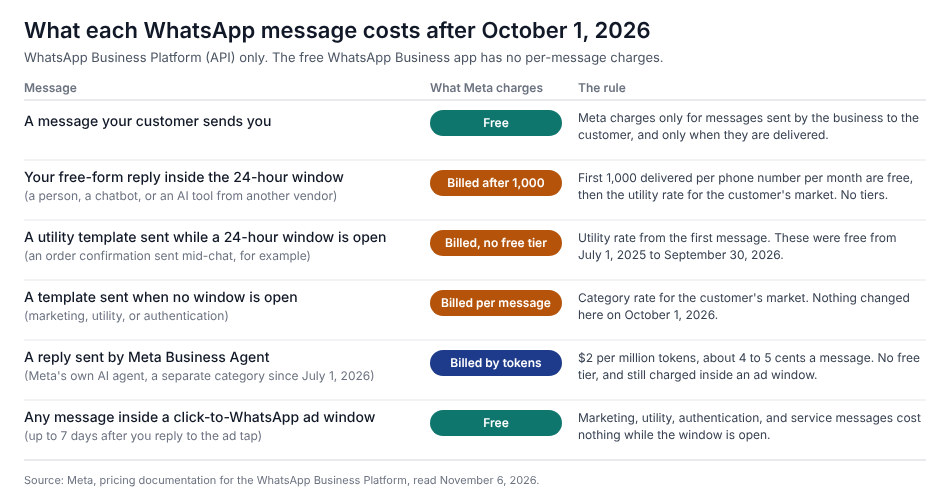
What each WhatsApp message costs after the October 1 change
Meta now charges for the replies you send inside a customer conversation
Two kinds of messages that were free are billable again. Service messages, free since November 1, 2024, are now charged per delivered message once a monthly free allowance is used up. Utility templates sent inside an open 24-hour window, free since July 1, 2025, are charged again from the first message. Both changes are in Meta's pricing update notice. Messages your customers send you are still free, and undelivered messages still cost nothing.
The free allowance is associated with the phone number. Meta's wording: "Each business phone number has one free tier of 1,000 delivered service messages per month. Meta charges as of the 1,001st service message per month, after the free tier has been used." Unused messages do not carry over, and the count resets on the first of the month for each number. If no payment method is on file, Meta delivers service messages for free and then stops delivering them. Through a CRM or a provider, the equivalent is your credit balance.
A month of replies costs a few dollars in some markets and real money in others
Take one phone number that delivers 3,000 service messages in a month, an illustrative figure chosen for the arithmetic. The first 1,000 are free, and 2,000 are billed. Those 2,000 cost $2.80 for customers in India, $6.80 in the United States, $44.00 in the United Kingdom, $50.00 in Indonesia, and $110.00 in Germany. The same 3,000 replies from Meta Business Agent at 4 to 5 cents each would cost $120 to $150, with no free tier.
The volume is the part you control. A bot flow that sends "Thanks for reaching out", then "One moment", then the answer, then "Anything else?" delivers four messages where one would do. Across 400 conversations, filler alone amounts to 1,200 messages, which use up the free tier before a person has typed a word.
The 24-hour window and the 7-day ad window work differently
The customer service window opens when a customer messages you, resets with each new message from them, and lasts 24 hours. Inside it, you can send any message type, and each free-form reply now counts toward the free tier and then bills at the service rate. After it closes, only templates can be sent, at their category rate.
The free entry point window is different. When a customer taps an ad that clicks to WhatsApp on an Android or iOS phone, and you reply within 24 hours, Meta opens a window that "may remain open for up to 7 days", and inside it, marketing, utility, authentication, and service messages are all free. Meta Business Agent replies are still charged. The 24-hour rule still applies inside it: after 24 hours of customer silence, you continue with a template, which is free while the ad window is open.
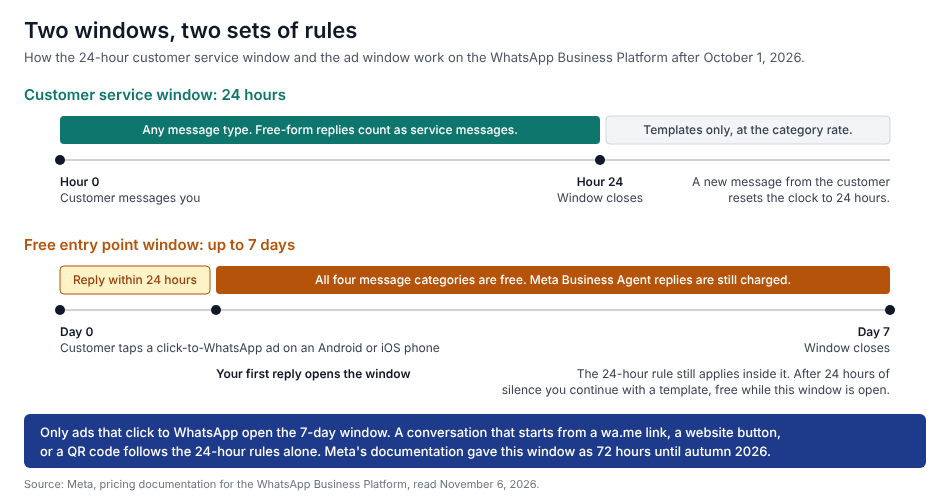
Two windows, two sets of rules.
Sending fewer messages is the only lever a small business has
None of this changes what Meta charges per message, so the bill comes down to how many messages your team sends. Turn off automated acknowledgments that carry no information. Answer in one message rather than four bubbles. Inside an open chat, a typed reply does the same job as a utility template and counts against the free tier first. Give bots a turn limit and a handover rule. Route each chat to one named owner so two people do not both reply. Then ask your provider whether it passes Meta's rate through at cost or adds a fee. Its October usage report shows how many service messages each number delivered; subtract 1,000 per number, then multiply the remainder by your market's rate.
Bigin connects WhatsApp conversations to your contact records.
Bigin is a small-business CRM from Zoho, and WhatsApp is one of its channels. You need to get the Express edition ($7 per user per month, billed annually, or $9 per user per month, billed monthly), or a higher edition, for the Messages module that sends, receives, and assigns WhatsApp chats. The Free edition only opens a chat in your WhatsApp app from a contact record. Each chat links to the matching contact and pipeline record, and approved templates can be sent from workflow rules.
Bigin does not change what Meta charges. It puts each conversation next to the rest of that customer's record, so the person replying can answer in one message instead of four. To see your WhatsApp chats next to your pipeline, start a 15-day trial of Bigin.
----
This article was developed with the assistance of AI tools, Claude, for research, fact-checking, cross-referencing, and drafting. While we have made every reasonable effort to verify the accuracy and reliability of the information presented, we encourage readers to independently verify any information before relying on it for personal, professional, commercial, or other purposes.