- Tamanna Kovoor
- Published: 01/23/2026
- Last Updated: 08/17/2026
Introduction
Most pipeline advice is written for companies that have a sales operations team. Weekly one-to-ones with every rep, scenario-based forecast models, behavioral coaching dashboards, and marketing and sales alignment workshops. Reasonable ideas if you have 12 salespeople and someone whose entire job is watching the numbers. If your sales team has three people and one of them is you, that advice needs to be translated before it can be used.
The translation matters more than it might seem, because failure modes differ at a small scale. A big team's pipeline breaks down due to inconsistency among reps. A small team's pipeline goes wrong because everyone is busy delivering the work they've already sold, and it quietly becomes a list of people who once seemed keen. Nobody notices until the quarter is half gone.
What follows is the version I would give a founder or a two-person sales team. It includes the arithmetic because that's where most of the value is hidden, and it names the specific numbers to pick rather than telling you to define a threshold and leave it to you.
What pipeline management covers, and how it differs from a funnel
Pipeline management is two jobs that get treated as one. The first is keeping an accurate picture of every open deal: where it stands, what it is worth, and when it is likely to close. The second is moving those deals along, or getting them out. Teams tend to do a passable job of the second and almost no job of the first, which is why forecasts miss.
The funnel is a different object, and the terms are carelessly swapped around. A funnel is a shape. It tells you what fraction of the people who entered came out the other end, so it is a diagnostic for your process as a whole. A pipeline is a list of named deals, each at a stage with a value and a date associated with it. The funnel tells you your conversion rate from qualified to closed is 22%. The pipeline tells you the Henderson deal has been sitting in Proposal for 41 days, and nobody has called them. You need both. Only one of them gives you something to do this morning.
11 best practices for sales pipeline management
1. Name stages after what the buyer did, not what you did
The most common pipeline I see at a small company has stages along the lines of New, Contacted, Following up, Interested, Quote sent, Closing. Four of those six describe what the seller did. Contacted means a rep sent an email. It says nothing about whether anyone read it, and a deal can sit in Contacted for six weeks while the rep feels productive.
Name every stage after the evidence the buyer produced instead. Demo attended with a second stakeholder in the room, rather than being done. Quote reviewed and pricing questions answered, rather than Quote sent. Interested becomes Described the problem in their own words, which is longer to write and much harder to fake.
TechTarget's 2025 guide makes the same argument, suggesting names along the lines of Budget confirmed and Executive sponsor engaged. Of everything on this list, this change does the most work because it repairs your reporting while also addressing your discipline. Once a stage means something observable, its conversion rate is a measurement rather than a record of rep optimism.
How many stages should you have
Five to seven. The reasoning is statistical rather than aesthetic. Every stage needs enough deals passing through it for its conversion rate to mean anything, and if you close 60 deals a year across 10 stages, some stages will see six deals a quarter. At that volume, every percentage you calculate is noise, and you will make decisions on noise because it arrives in a chart, and charts look authoritative.
There is a human cost to extra stages, too. Each one is another place for a deal to park and another judgment call for a rep at six on a Friday. Bigin allows up to 25 stages per sub-pipeline, which is considerably more rope than a small team should take.
2. Write exit criteria as fields, not intentions
Everyone says to define your exit criteria. Very few teams write them in a form that survives a busy week. An exit criterion that lives in a shared document is a suggestion. An exit criterion that lives as a required field on the deal record is a rule, and the difference shows up in your forecast within a month.
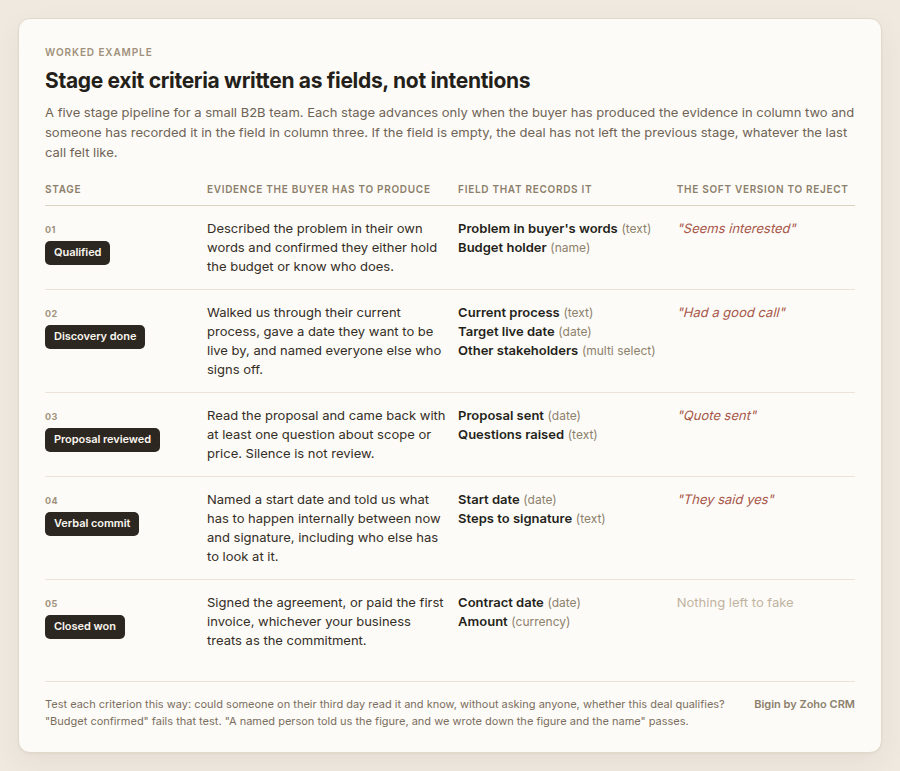
A well-defined set of exit criteria for a five-stage pipeline. The third column is the part most teams skip, and it is the part that makes the criterion enforceable.
Enforcement is the other half. A reminder that fires after the fact do not work, because by then the deal has already moved and the field is already empty. What works is a system that refuses the move. In Bigin, stage transition rules do this from the Premier plan up: you nominate the fields that have to be filled before a record can enter a given stage, and the move is blocked until they are. Other tools have their own versions of the same idea under different names. The principle carries over regardless, and it is not a technical one. If the pipeline can be advanced without evidence, someone will advance it without evidence, usually the person having the worst week.
One caution. Do not require eight fields per stage. Two or three, chosen because they change a decision, or reps will start typing "n/a" and you will have built a compliance exercise instead of a qualification step. If you want a fuller treatment of what to ask before a deal is worth qualifying at all, our guide to lead qualification covers the frameworks and where each one earns its keep.
3. Work out how much pipeline you need instead of borrowing a rule
You will hear that you need 3x your target in the open pipeline. It gets repeated as though it were a law of physics. It comes from simple arithmetic: if you win one qualified deal in three, you need three deals for every one you have to win. Which means the rule is correct only when your win rate is 33%.
Small businesses frequently do not have a 33% win rate, in either direction. A consultancy closing referrals and repeat work might win half of everything it qualifies. A team doing cold outbound into a committee might win one in five. Applying 3x to both is how you end up panicking through a healthy quarter and relaxing through a doomed one, and the doomed one is the expensive mistake because you find out with six weeks left.
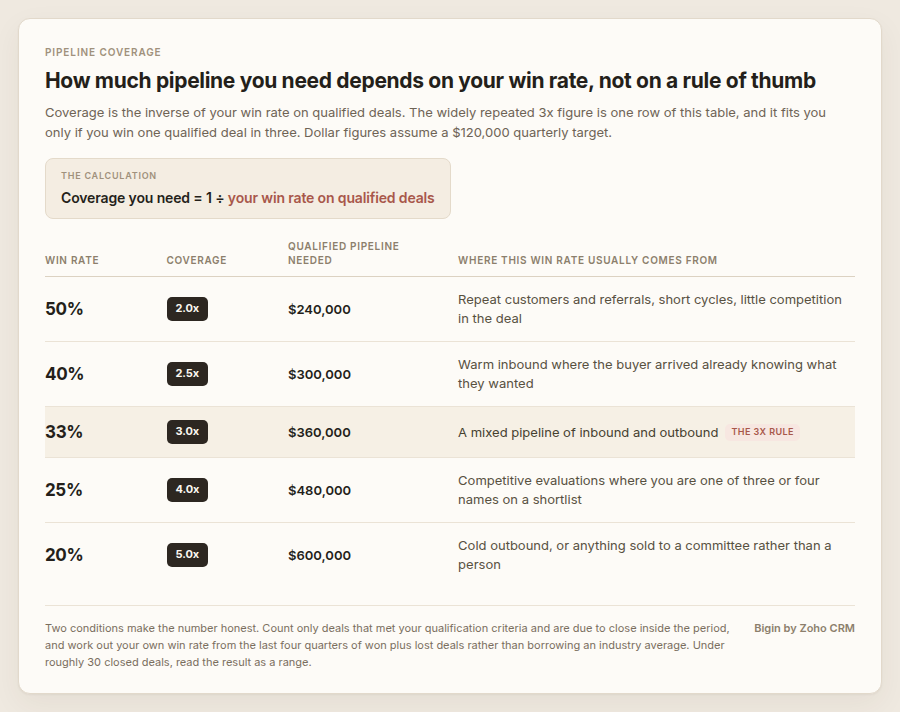
Coverage is the inverse of your win rate. The 3x rule is one row of this table.
Getting your own win rate takes 20 minutes. Pull the last four quarters. Count the deals you won. Count the deals you lost, including the ones that went quiet and were never formally closed. Divide wins by the total of the two. Use only deals that reached your qualified stage, because including every inquiry that ever landed will give you a number so low it is useless for planning.
Two conditions keep the answer honest, and they are where most teams lose it. Count only qualified deals with a close date inside the period you are forecasting, since a promising deal due in November tells you nothing about September. And if you have fewer than about 30 closed deals to work from, treat the output as a range rather than a figure. A win rate calculated from 11 deals can move by 8 percentage points based on a single outcome.
4. Give every open deal a dated next step
This is the cheapest habit on the list and the one with the largest return. A deal with no scheduled next action is not being worked; it is being remembered, and memory is the least reliable component in any sales process.
The time budget explains why. Salesforce's State of Sales, seventh edition, published in February 2026, based on a survey of 4,050 sales professionals, found that the average seller spends 40% of their time selling. The rest goes to admin, research, internal meetings, and tool transitions. That is a full-time salesperson. A founder selling alongside everything else might have six genuine selling hours in a week, and six hours is not enough to also carry 30 open deals in your head.
The rule is simple enough to hold: no deal leaves a conversation without a date in the calendar and a line in the record. If the buyer will not commit to a date, that itself is information and belongs in the record, too.
Log the interaction against the deal rather than leaving it in your inbox. This feels like bureaucracy when you are the only person selling, and it is, right up to the week you are ill or on a plane, and someone else has to pick up a live deal. An email thread in a personal mailbox is invisible to everyone else in the company.
5. Put a number on "stalled" and set a hard deck for dead deals
Reviewing your stalled deals is advice you cannot act on, because nobody has told you what stalled means. Pick a definition and write it down. If you have enough history, use a multiple of the median time deals spend at that stage; 1.5x is a sensible starting point. If you do not have the history yet, use a flat rule: 21 days with no response from the buyer.
Then the uncomfortable part. Matthew Dixon and Ted McKenna analyzed more than 2.5 million recorded sales conversations for research published in Harvard Business Review in June 2022 and found that between 40% and 60% of deals are lost to buyers who say they intend to purchase but never act. Not lost to a competitor. Lost to nothing happening. Of those, they found that 56% were buyers who wanted to change but could not get there, and 44% preferred to stay as they were. It is a 2022 study, and I have not found anything more recent at that scale, so read the range as an order of magnitude rather than a precise figure.
Order of magnitude is enough to change how you manage a pipeline. It means roughly half your open deals are heading for no decision, and the ones sitting longest are disproportionately in that half. Dixon and McKenna's own recommendation is to set a hard deck: an age past which a deal is closed, regardless of how the last call felt.
Twice your median sales cycle is a defensible starting point. If your median cycle is 45 days, anything past 90 days with no buyer-initiated activity goes to Closed Lost with a reason code and a re-engagement date three months out. Not deleted, and not written off as a bad lead. Closed, with a note about what would have to change for it to come back, because circumstances do change, and a new operations director is a genuine reason to call again.
None of this is about tidiness. Zombie deals inflate your coverage ratio, which corrupts your forecast, which then corrupts your hiring and spending decisions. A pipeline that lies to you is worse than no pipeline, because you act on it.
6. Watch the shape of the pipeline, not just the total
Salesforce's own training material has a frame here that I would borrow outright, because it is the most useful idea in the top search results, and almost nobody repeats it. A pipeline can be top-heavy or bottom-heavy, and both are problems that a healthy-looking total will hide.
Top-heavy means plenty entering and little reaching the late stages. You have a qualification or discovery problem, the total pipeline value looks reassuring, and the revenue will not arrive. Bottom-heavy means plenty of closing and nothing new entering. This quarter looks excellent. Next quarter is a cliff, and because your sales cycle is longer than your attention span, you will discover it far too late to fix.
Check monthly. Count the deals and the value at each stage, express each as a share of the total, and write down what a normal month looks like for you. Once you have three or four months of that, drift becomes visible.
At a small company, the drift almost always has one cause: a busy delivery month, where everybody stopped prospecting to do the work they had already sold. That is the small-business sawtooth, and no amount of CRM discipline will fix it because the problem is not the pipeline. The fix is to book prospecting time in the calendar before the delivery work eats it, and to treat that block as unmovable, in the same way a client meeting is.
7. Get stage probabilities from your own history, or skip them
Stage probabilities are where forecasts go to become fiction. The usual advice is to assign something like 20% at discovery and 70% at negotiation, and those numbers are as good as any other invented numbers, which is the problem with them.
If you have enough closed deals, derive the figures. Of the deals that reached Discovery in the last 12 months, what share eventually closed? That is your Discovery probability. Repeat per stage. It is a half-hour spreadsheet exercise, and the output beats any default, partly because it is right and partly because arguing about it forces a conversation about what each stage means.
If you do not have enough closed deals, and enough here is roughly 50, weighted forecasting will hand you a precise-looking number containing no information. Forecast by naming deals instead. List every deal you believe will close this period, with a date and a one-line reason you believe it, then add them up. That is your commitment. It is cruder and more honest for it, and it forces the conversation that a percentage lets you avoid.
One rule holds either way. Do not let a rep override stage probability on instinct. If someone's confidence in a deal is real, it should show up as movement to the next stage, and movement requires meeting the exit criteria. Confidence that cannot clear that bar is a feeling, and feelings do not belong in a revenue number.
8. One review a week, 30 minutes, in a fixed order
Enterprise cadence is weekly one-to-ones, plus a monthly team review plus a quarterly business review. For a team of two to five, that is more meetings than selling. Run one session a week, half an hour, everyone in it.
The order of the agenda matters more than the agenda:
- Deals that have changed stage since last week. Move fast. This is the good news, and it should take four minutes.
- Deals that should have changed stage and did not. This is the meeting. Each one gets a specific answer: what the next step is, who is doing it, and by when. "I will chase them" is not an answer.
- Deals past the stall threshold. A decision is required for everyone, either a specific revival action or a close. No deal survives this section twice.
- What entered the pipeline this week? If the answer is nothing, the output is prospecting time on next week's calendar, not a shrug.
Do not walk the whole pipeline deal by deal. With 40 open deals, you will give each one 45 seconds and learn nothing about any of them. Review by exception, which is what the order above does for you.
Selling on your own? Same agenda, same 30 minutes, in your own calendar, pipeline open on the screen. Saying it out loud to an empty room is less absurd than it sounds and much better than not doing it, mostly because the second item is one you will skip if you are only thinking rather than answering.
9. Split pipelines when the stages diverge, not when the products do
A common mistake is to have a separate pipeline for each product line or salesperson. That is the wrong axis. The question is whether the stages are the same. If two kinds of deals go through identical steps with identical exit criteria, they belong in a single pipeline, with a field to distinguish them. If the steps genuinely differ, they need separate pipelines.
Cases where a second pipeline earns its place at a small company are narrower than most people expect. New business and renewals qualify, because renewal stages have almost nothing in common with new business stages. Sales and onboarding qualify, because a signed contract is the start of the delivery process rather than the end of anything. Partner or referral deals sometimes qualify when the first few steps involve the partner rather than the buyer. Beyond that, use a field.
Over-splitting has a real cost. Your reporting fragments, cross-pipeline reporting gets harder in every tool I have used, and nobody can tell you the total pipeline value without adding four numbers together, which means nobody does.
On the tooling: Bigin gives you one Team Pipeline on the free plan, three on Express at $7 per user per month, billed annually, and five on Premier at $12 per user per month, both on the same basis. Sub-pipelines sit inside a Team Pipeline, so process variants do not each need their own pipeline. Connected Records, available from Express upward, automatically moves a record from one Team Pipeline to another, which is the mechanism that turns a won deal into an onboarding record without anyone retyping it.
10. Track four metrics well
I would rather see a small team track four metrics carefully than 14 badly. Salesforce's training material lists eight, Pipedrive's guide lists five, and for a business of this size, most of them are downstream of the four below.
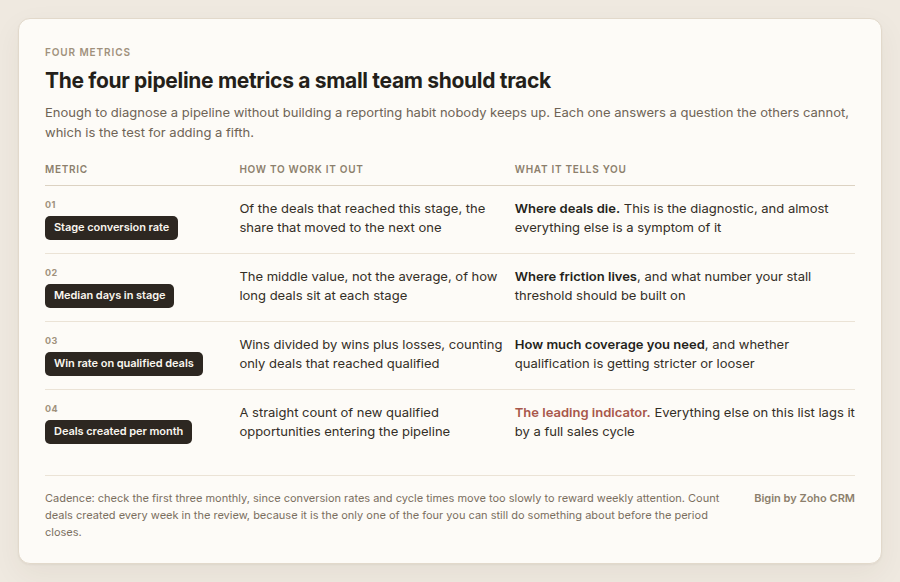
Use the median for time in the stage rather than the average. One deal that sat for 400 days before someone closed it will drag an average far enough to make the number meaningless, and small samples make that likelier, not less.
Sales velocity, the formula everybody quotes, multiplies deal count by average value by win rate and divides by cycle length. It is fine as a single figure for a board slide. As a diagnostic, it is weak because four inputs move at once, and the output cannot tell you which one moved. Track the inputs and calculate velocity afterward if somebody asks for it.
11. Keep the pipeline in one place
A spreadsheet is a perfectly good pipeline for one person who opens it daily. It stops working at two specific moments, and knowing them saves you a lot of arguments. The first is when a second person needs to write to it. The second is when you need something to happen at a time, whether that is a reminder, a follow-up, or a notification when a deal changes stage. A spreadsheet has no clock and no memory, and no amount of conditional formatting gives it either.
The subtler failure is a CRM alongside a shadow spreadsheet. The forecast lives in the spreadsheet because the CRM's numbers were wrong once. Nobody trusts the CRM, so nobody updates it, so the forecast has to live in the spreadsheet. That loop closes fast, and it is difficult to reopen. Pick one system. If it cannot produce the number you need, fix its fields rather than keeping a second set of books, and if it genuinely cannot be fixed, that is a reason to change tools rather than a reason to run two.
Worth saying plainly: this is the one practice on the list where the tool matters. The other 10 are habits, and habits work in a spreadsheet, on paper, or in an enterprise platform. If you are weighing options, we keep a comparison of free lead management software with the current plan limits, and a longer piece on deal management and pipeline control that goes into the mechanics in more detail.
A 30-day plan for a pipeline that has gotten away from you
If the pipeline is a mess right now, the order of operations counts for a lot. Cleaning before restructuring saves work, and most people do it the other way round.
Week one: count and clean, change nothing
Export every open deal. For each one, answer three questions. When did the buyer last respond, not when did you last email them? What is the next step, and what date is it on? Is the close date still plausible if you say it out loud? Deals that fail all three go to Closed Lost with a reason. Resist the urge to redesign anything yet, because you will redesign around deals that are about to disappear.
Week two: set the stages
Five to seven stages, named after buyer evidence, with a one-sentence exit criterion for each. Then re-stage every surviving deal against the new definitions. Some will move backward, and that is the point, rather than a problem. A deal that drops from Negotiation to Discovery was never in Negotiation, and knowing that now is worth more than the small unpleasantness of admitting it.
Week three: turn on enforcement
Required fields per stage. A stall threshold with a number. A hard deck. Then, at most two automations: one that flags a deal with no activity past the threshold, and one that creates a follow-up task when a deal changes stage. The temptation is to build 15 automations in the first week. Build two, live with them for a month, and add more only when a specific repeated annoyance justifies each one.
Week four: get your numbers
Pull the last 12 months of closed deals. Calculate win rate and stage conversion. Work out your coverage requirement based on the win rate, then compare it to the qualified pipeline you now have after three weeks of cleaning. This is the week you find out whether the quarter is real, which is uncomfortable, and far better than finding out in week 11.
Then run the weekly review and change nothing structural for a full quarter. You need one clean quarter of data before you can tell whether a change helped, and teams that redesign monthly never get one.
Where Bigin fits
Bigin is built for the small end of this. Pipelines are the primary object rather than a feature bolted onto a contact database, kanban is the default view on every plan, including the free one, and setup is short enough that a two-person team can move from spreadsheet to working pipeline in an afternoon rather than a quarter.
Three things map onto the practices above. Stage transition rules, from Premier upward, make named fields mandatory before a deal can enter a stage, which turns exit criteria from a reminder into a rule. Team Pipelines with sub-pipelines let you separate new business from renewals or onboarding within one tool, with Connected Records automatically moving deals between them. And the free plan is a real plan rather than a trial: one user, 500 records, one pipeline, three automations, no expiry, and no card.
The limits are worth stating just as plainly. That single free seat means the moment a second person needs to write to the pipeline, you are on a paid plan. Stage transition rules, multi-currency, and the AI features start at Premier, not Express, so the enforcement mechanism described above is not available on the cheapest paid tier. And teams heading past roughly 20 people, or anyone who needs territory management and proper forecast modeling, will outgrow Bigin and end up migrating to Zoho CRM. If you can already see that coming, start there instead.
Bigin's free plan takes about 10 minutes to set up, with one pipeline and 5 stages, which is enough to try the exit-criteria idea on real deals before committing to anything. Start free, or read the plan limits first.
FAQs
How many stages should a sales pipeline have?
Five to seven for most small businesses. The constraint is data volume rather than taste: each stage needs enough deals flowing through it for its conversion rate to mean anything, and a team closing 60 deals a year, spread across 10 stages, will be reading noise. Add a stage only when a real decision happens there that no existing stage captures.
What is a good pipeline coverage ratio?
The one that matches your win rate, which is 1 divided by your win rate on qualified deals. The familiar 3x figure assumes you win one deal in three. If you win half of what you qualify, 2x is enough, and chasing 3x wastes the effort you should be spending on closing. If you win one in five, 3x guarantees a miss, and you need closer to 5x.
How often should you review your sales pipeline?
Once a week for deal movement, once a month for shape and metrics. The weekly session can be 30 minutes if you review by exception, starting with deals that should have moved and did not, rather than walking every record. Monthly, look at the distribution of deals across stages and your stage conversion rates, which move too slowly to be worth watching weekly.
When should I mark a deal as lost?
When it passes your hard deck, which is a threshold you set in advance rather than a judgment you make deal by deal. Twice your median sales cycle with no buyer-initiated activity is a reasonable starting point. Close it with a reason code and a re-engagement date rather than deleting it, since a change in budget or personnel can genuinely reopen deals.
What does a healthy sales pipeline look like?
Deals distributed across stages rather than piled at either end, every open deal carrying a dated next step, close dates that have moved when reality moved, and enough qualified value in the current period to cover your target at your actual win rate. A high total value proves nothing on its own, and it is the number most likely to be reassuring you while the quarter falls apart.
What is the difference between a sales pipeline and a sales funnel?
The funnel is a shape that shows what proportion of prospects converted at each step, so it diagnoses your process. The pipeline is a list of specific open deals with a stage, a value, and a date against each. The funnel tells you 22% of qualified deals close. The pipeline tells you which deal has been stuck for six weeks.
Should I use one pipeline or several?
Split when the stages differ, not when the products do. Two product lines that follow the same steps belong in a single pipeline, with a field distinguishing them. New business and renewals belong apart, because the stages have nothing in common. Sales and onboarding belong apart for the same reason. Splitting further than that fragments your reporting for no gain.
Why are my sales forecasts always wrong?
Usually one of three things, and often all three. Close dates that were never updated after the deal slipped, so the forecast contains deals that stopped being plausible weeks ago. Stage probabilities are invented rather than derived from your own history. And dead deals are still sitting open, inflating both coverage and the weighted total. Fixing the third one alone tends to move forecast accuracy more than any modeling change.
How do I know when a deal has stalled?
Define it numerically before you need it. Either 1.5 times the median time deals spend in that stage, if you have enough history to calculate a median, or a flat 21 days with no response from the buyer if you do not. Time since the buyer replied is the measure to use, not time since you last emailed them, since the second one is easy to game without meaning to.
Can I manage a sales pipeline in a spreadsheet?
Yes, if you are one person and you open it every day. It stops working at two points: when a second person needs to write to it, and when you need something to happen at a time, like a reminder or a follow-up task on a stage change. A spreadsheet has no clock. Most small teams outlast their spreadsheet by several months and pay for it in missed follow-ups.
What percentage should I assign to each pipeline stage?
Whatever your own history says. Take the deals that reached each stage in the last 12 months and calculate the share that eventually closed. If you have fewer than about 50 closed deals, skip weighted forecasting altogether and forecast by naming individual deals with a date and a reason. A weighted number built on invented percentages looks precise and carries no information.
How do I clean up a messy pipeline without losing real deals?
Test each open deal against three questions: when the buyer last responded, what the next dated step is, and whether the close date is still plausible. Deals failing all three get closed. Deals failing one or two get a specific action with a date. Nothing gets deleted, and everything closed gets a reason and a re-engagement date, so a deal that was merely dormant can be picked up again rather than lost.
----
Article updated in August 2026 | Edited by: Anubhav Sarker | Images created using AI. Please verify carefully before using