- HOME
- Entrepreneurship
- How can small businesses get the best out of their employees?
How can small businesses get the best out of their employees?
- Published : February 25, 2026
- Last Updated : February 25, 2026
- 447 Views
- 8 Min Read
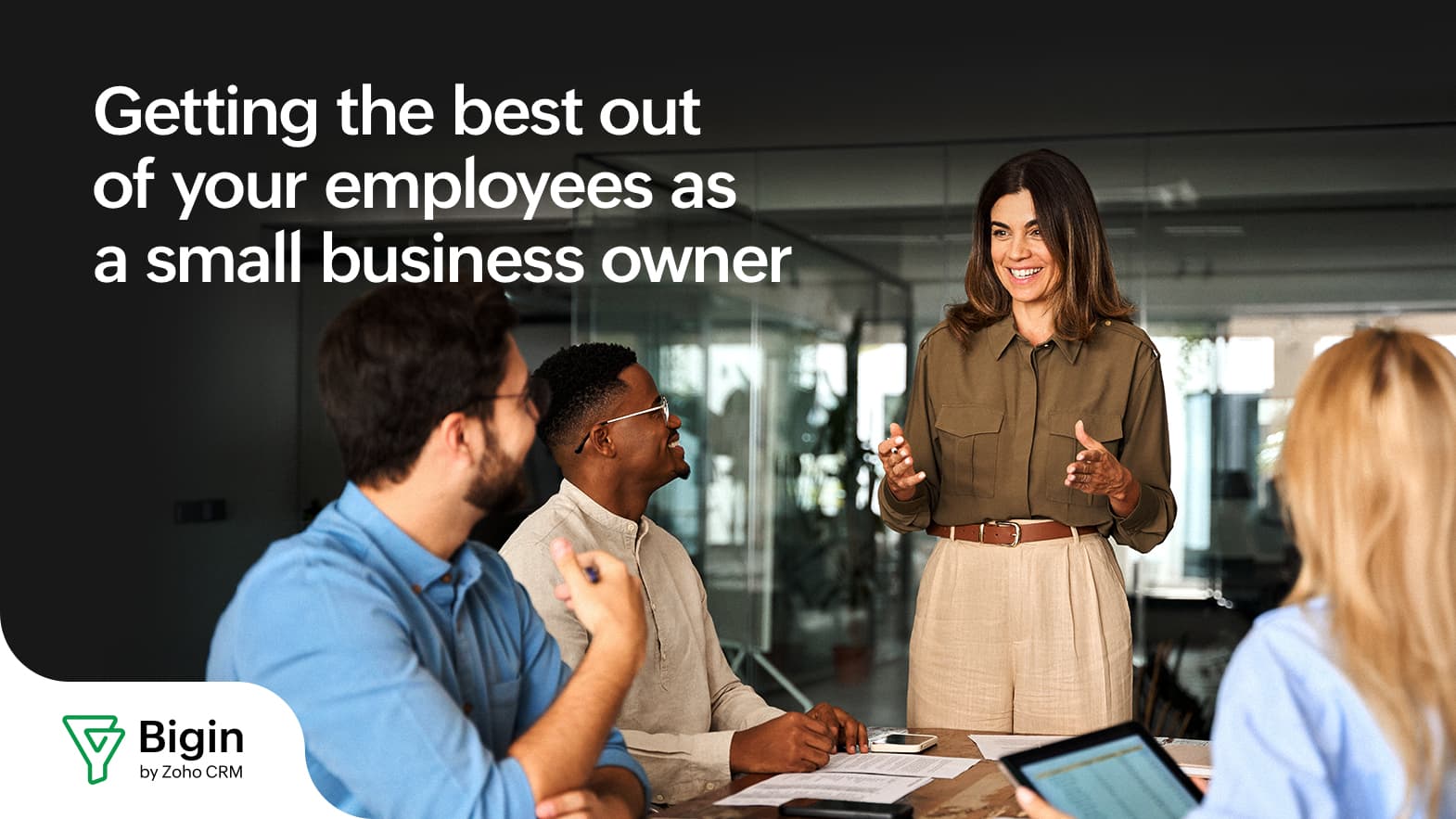
Small businesses make up 99.9% of all U.S. businesses and employ roughly 45.9% of the private-sector workforce (U.S. Small Business Administration). That's nearly half of working America, powered by companies that often run on tight margins, small teams, and founders who wear every hat imaginable.
But here's the uncomfortable truth: Having employees and succeeding with employees are two very different things. The average organization loses 18% of its workforce every year, with voluntary turnover accounting for 76% of all departures (Bureau of Labor Statistics via Second Talent/SHRM). For small businesses—wherein every person carries an outsized share of the workload—losing even one team member can destabilize operations for months.
So what separates the small businesses that thrive with their people from the ones constantly stuck in a hiring-and-replacing loop? It comes down to a handful of principles that are easy to understand but hard to execute consistently.
The real cost of getting it wrong
Before talking about what works, it's worth understanding what's at stake. Replacing an employee can cost anywhere from 50% to 200% of their annual salary, depending on the role (Gallup Workplace Research). For a small business paying someone $50,000 a year, that's $25,000 to $100,000 in lost productivity, recruitment costs, training time, and institutional knowledge walking out the door.
Moreover, the damage runs deeper than the balance sheet. A 2025 Bank of America Business Owner Report found that 40% of small businesses cite labor shortages as a top concern (Bank of America / Bank of America Institute, 2025). When positions stay open, existing employees absorb the extra work. That leads to burnout, which triggers more departures, which creates more openings. It's a vicious cycle that can hollow out a team fast.
Two-thirds of small business owners (66%) say hiring workers is difficult (NEXT Insurance, 2025). The main reasons? A lack of skilled applicants (17%), an inability to offer competitive benefits (13%), and more attractive opportunities elsewhere (11%) (NEXT Insurance, 2025). When you can't outspend bigger companies on salaries and perks, you have to outthink them.
Hire for fit, not just skill
The most successful small businesses have figured out something counterintuitive: The perfect resume doesn't guarantee the perfect hire. Lou Haverty, who runs Tank Retailer, put it well when he noted that what mattered most wasn't an employee's product familiarity but rather their personality and engagement style (NEXT Insurance, 2025). Skills can be taught; attitude and cultural alignment are much harder to develop after the fact.
Robert Half's research backs this up. More than four in 10 SMB hiring managers say finding candidates who align with company culture is a persistent struggle (Robert Half, 2024). The businesses that solve this problem tend to do a few things differently: They write honest job descriptions that reflect the actual day-to-day—not a wish list; they involve current team members in the hiring process; and they screen for values and working style—not just technical qualifications.
Daniel Roberts, CEO of Lava Roofing, took this approach and saw turnover drop by 17% (NEXT Insurance, 2025). His team told him they valued flexibility and clear growth paths, so he built those into the hiring pitch. The lesson? Your current employees will tell you exactly what attracts and retains good people, if you ask.
Onboarding is where most small businesses fail
Here's a stat that should make every small business owner uncomfortable: Only 12% of employees strongly agree that their company does a great job with onboarding (Gallup, 2023 via SHRM). And 33% of new hires leave within the first 90 days, often because of poor onboarding experiences (Enboarder, 2025).
For larger companies, this is a problem. For small businesses, it can be existential. When you've spent weeks finding the right person and they leave before their third month, you've burned time, money, and team morale for nothing.
Structured onboarding changes this equation dramatically. Employees who go through a well-designed onboarding process are 69% more likely to stay for at least three years (Glassdoor). Yet 41% of small businesses still rely entirely on manual onboarding processes, like handing someone a folder on day one and hoping for the best (Small Business Trends via Newployee, 2025).
Effective onboarding doesn't require expensive software or a dedicated HR team; it requires intentionality—like having a clear 30/60/90-day plan, assigning a buddy or mentor, making sure the new hire meets everyone in their first week, or setting short-term goals so they can experience quick wins. Research from Gallup shows that employees rate their onboarding experience 3.5 times higher when their manager actively participates in it (Gallup via Devlin Peck). That's a free intervention with a massive payoff.
Build a culture that makes people want to stay
Compensation matters. Let's not pretend otherwise. But research consistently shows that money alone doesn't keep people. According to Gallup, 67% of employees cite poor management as their primary reason for leaving, and 79% of employees who feel valued by their employer are significantly less likely to look elsewhere (Gallup Workplace Research via Second Talent/SHRM).
For small businesses, this is actually an advantage. In a 10-person company, the founder or manager interacts with every employee regularly. That proximity creates opportunities for recognition, feedback, and genuine connection that a 10,000-person corporation can't replicate.
The data on recognition is especially compelling for small teams. According to Gallup, 80% of employees say regular recognition improves their loyalty to their organization (Gallup via Thirst, 2025). This doesn't mean throwing pizza parties or handing out gift cards; it means noticing specific contributions, acknowledging them promptly, and making people feel like their work matters. A Slack message that says "your work on the Henderson account was thorough and it's the reason we kept them" does more for retention than an annual bonus in many cases.
Companies with high employee engagement see 24% lower turnover and 21% higher productivity (Gallup Workplace Research). For a small business, that productivity gap alone can mean the difference between growth and stagnation.
Invest in growth, even when you're small
One of the most persistent myths in small business is that you can't offer career development because there's nowhere to "move up." But career growth doesn't have to mean a new title every 18 months. It can mean learning new skills, taking on different responsibilities, or gaining exposure to parts of the business that were previously invisible.
LinkedIn Learning found that 93% of employees say they're more likely to stay with an organization that invests in their career development (LinkedIn Learning Workplace Learning Report). And companies that prioritize learning and development retain 17% more employees than those that don't (LinkedIn Learning Workplace Learning Report).
For small businesses, this might look like sending someone to an industry conference, giving them ownership of a new initiative, or creating a small annual learning budget. WGU Labs found that 87% of companies worldwide face a skills gap (WGU Labs via U.S. Chamber of Commerce, 2025), which means upskilling your current team isn't just a retention strategy; it's a competitive necessity.
The key is to have these conversations regularly, not just during annual reviews. 45% of departing employees say their manager never proactively discussed how their job was going (Gallup via Appical, 2025). That's a missed opportunity that costs nothing to fix.
Flexibility is no longer a perk; it's infrastructure
Remote and hybrid work aren't pandemic relics. They're now structural expectations. Surveys show that 58% of workers consider remote work arrangements important (Nectar HR, 2025), and 83% of workers globally prioritize work-life balance over salary (Paradigm IE, 2025).
For small businesses competing against larger employers, flexibility is one of the most powerful tools available, and it costs nothing. Lou Haverty found that offering 100% remote work became his biggest competitive advantage in hiring, especially as larger companies pushed return-to-office mandates (NEXT Insurance, 2025).
Flexible work arrangements have been shown to increase retention by 25% (Gartner). But flexibility means more than just work location; it includes schedule adjustability, autonomy over how work gets done, and trust that adults will manage their own output without micromanagement.
Systematize before you scale
Small businesses that succeed with employees tend to have one thing in common: They build systems early. That doesn't mean bureaucracy, but repeatable processes for the things that matter most, like how you onboard someone, how you track customer relationships, how you follow up on leads, and how you communicate priorities across the team.
When everything lives in the founder's head, the business can't scale, and employees can't operate independently. Every question has to go through one person, creating bottlenecks that frustrate everyone.
This is where lightweight tools earn their keep. A small business doesn't need enterprise software, but it does need a central place where customer information, tasks, and team communications live. A CRM purpose-built for small teams—like Bigin by Zoho CRM—can eliminate the chaos of scattered spreadsheets and sticky notes and give every employee visibility into what matters without overwhelming them with complexity. When new hires can see the full picture of customer relationships and workflows from day one, they ramp up faster and contribute sooner.
The bottom line
Small businesses that succeed with employees don't do so because they have unlimited budgets or fancy perks. They succeed because they treat hiring, onboarding, development, and culture as interconnected systems rather than afterthoughts.
The math is straightforward: Companies with high retention are 22% more profitable (TeamOut, 2025). Engaged teams produce 21% more (Gallup Workplace Research). Structured onboarding cuts early turnover dramatically. And the cost of getting it right is almost always less than the cost of getting it wrong.
Every small business will face constraints. You won't always match the big company's salary or benefits package. But you can offer something they can't: proximity, flexibility, genuine recognition, and a real stake in the outcome. Those advantages are worth more than most founders realize, provided you build the systems to deliver them consistently.
Sources
U.S. Small Business Administration (SBA) — Small business employment data
Bureau of Labor Statistics — Workforce turnover and compensation data
Gallup Workplace Research — Employee engagement, retention, and recognition studies
Bank of America 2025 Business Owner Report — Small business labor concerns
NEXT Insurance Small Business Hiring Data (2025) — Hiring difficulty statistics
Robert Half SMB Hiring Research (2024) — Salary and cultural fit challenges
Glassdoor — Onboarding and retention research
LinkedIn Learning Workplace Learning Report — Career development and retention
SHRM (Society for Human Resource Management) — Onboarding and employee satisfaction data
WGU Labs Report — Skills gap and upskilling data (via U.S. Chamber of Commerce)
Paycor Employee Retention Statistics (2025) — Turnover prevention data
BambooHR — New hire decision-making and onboarding statistics
Gartner — Flexible work and retention research
TeamOut Employee Retention Statistics (2025) — Profitability and engagement data
Second Talent/SHRM — Retention investment ROI data
Enboarder (2025) — Onboarding attrition data
Nectar HR (2025) — Remote work preference survey
Devlin Peck / Gallup — Manager involvement in onboarding
Thirst / Gallup (2025) — Recognition and loyalty data
Appical / Gallup (2025) — Manager proactivity and departures
Paradigm IE (2025) — Work-life balance global survey
Small Business Trends via Newployee (2025) — Manual onboarding processes
 Anubhav
Anubhav is a product marketer with an insatiable thirst for all things content marketing, technology, and SaaS. His expertise lies in crafting compelling narratives that resonate with audiences and drive business growth. With a deep-rooted interest in entrepreneurship, Anubhav closely follows the latest industry trends and innovations, constantly seeking new ways to elevate marketing strategies.